What Colors Mixed Together Will Make Blue? (Complete Guide with Charts, Science & Real Data)
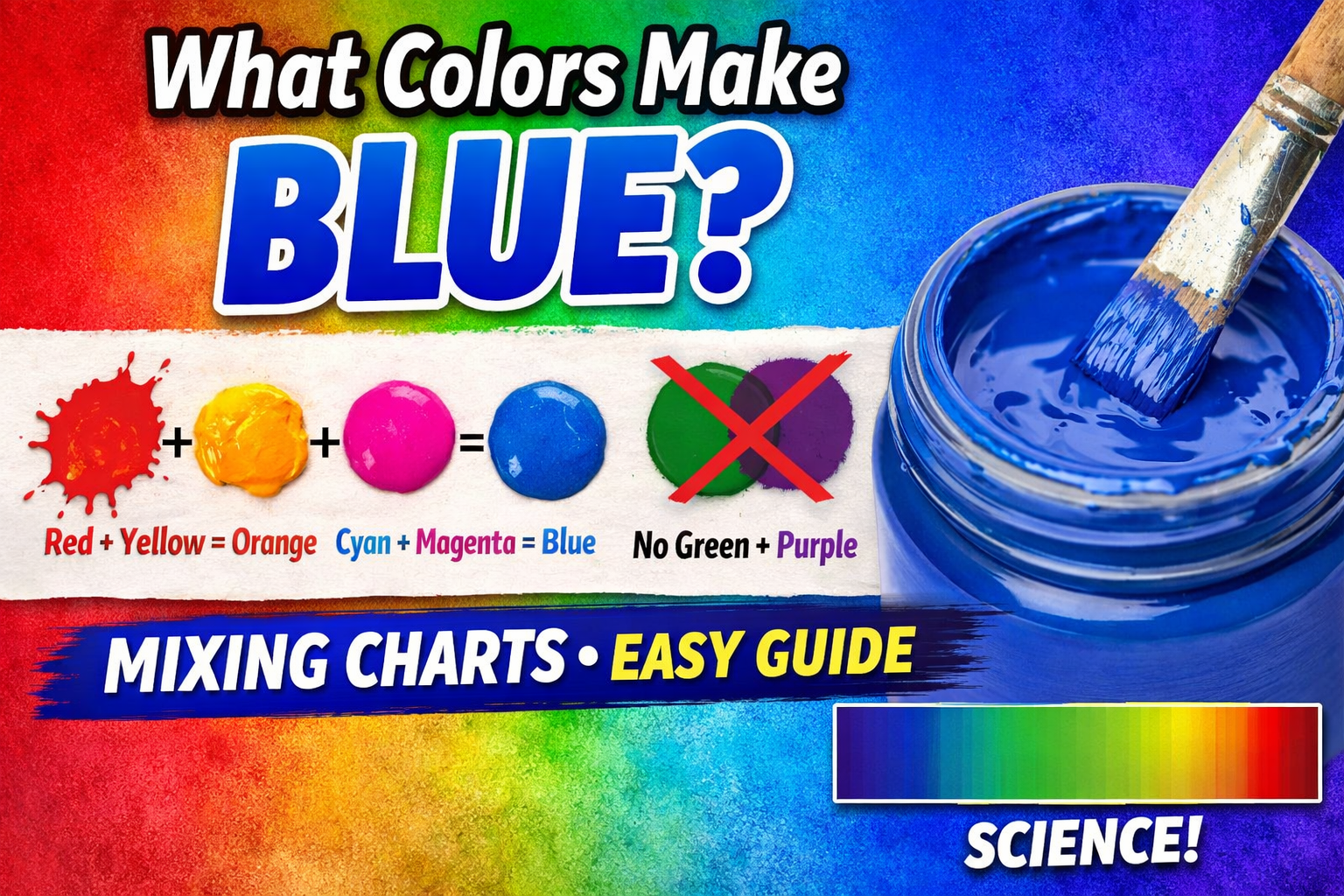
At first glance, the question seems simple: what colors make blue?
But the real answer depends on how color works in different systems—from paint and printing to digital screens and light physics.
In this detailed guide, you’ll learn:
- Whether blue can actually be created by mixing
- The science behind color wavelengths
- Real mixing charts and data
- Practical paint formulas and examples
Understanding the Basics: Is Blue a Mixable Color?
In traditional art, based on the RYB color model (Red, Yellow, Blue):
- Blue is a primary color
- Primary colors cannot be created by mixing others
👉 Simple truth:
You cannot mix colors to make pure blue—you must start with it.
The Science Behind Blue (Why It Can’t Be Mixed)
Color exists because of light wavelengths.
| Color | Wavelength Range |
|---|---|
| Red | 620–750 nm |
| Green | 495–570 nm |
| Blue | 450–495 nm |
Blue sits at a specific part of the visible spectrum.
In paint:
- Pigments absorb light
- Mixing colors removes wavelengths
- You cannot “add” blue if it’s not already present
👉 Result:
No blue pigment = no blue outcome
Color Systems Explained (Why Answers Change)
Different industries use different color models:
| System | Type | Primary Colors | Can it Make Blue? |
|---|---|---|---|
| RYB color model | Paint | Red, Yellow, Blue | ❌ No |
| RGB color model | Light | Red, Green, Blue | ❌ No |
| CMY color model | Ink | Cyan, Magenta, Yellow | ⚠️ Approximate |
👉 Key insight:
Blue is almost always a starting point—not a result
The Only Exception: Printing (CMY Model)
In printing, you can create a blue-like color:
| Mix | Result |
|---|---|
| Cyan + Magenta | Blue / Indigo |
Why this works:
- Cyan reflects blue-green light
- Magenta reflects red + blue components
Together, they simulate blue—but it’s not perfectly pure.
Traditional Paint Mixing Chart
Primary Colors (Cannot Be Made)
| Color | Can Be Mixed? |
|---|---|
| Red | ❌ |
| Yellow | ❌ |
| Blue | ❌ |
Secondary Colors (What You CAN Make)
| Mix | Result |
|---|---|
| Red + Yellow | Orange |
| Yellow + Blue | Green |
| Blue + Red | Purple |
👉 Notice:
Blue never appears as a result—only as an input
Digital Color Data (RGB System)
Screens use light instead of pigment.
| Color | RGB Code |
|---|---|
| Blue | (0, 0, 255) |
Mixing Examples:
| Mix | Result |
|---|---|
| Red + Green | Yellow |
| Red + Blue | Magenta |
| Green + Blue | Cyan |
👉 Again:
Nothing creates blue—it must already exist
Practical Blue Mixing (Real Paint Ratios)
Even though you can’t create blue, you can modify it:
Light Blue (Sky)
- 80% White
- 20% Blue
Ocean Blue
- 70% Blue
- 20% Green
- 10% White
Dark Blue (Navy)
- 85% Blue
- 10% Black
- 5% Purple
Indigo
- 70% Blue
- 30% Red
Full Color Mixing Outcome Chart
| Colors Used | Result | Explanation |
|---|---|---|
| No blue present | ❌ No blue | Missing wavelength |
| Cyan + Magenta | ✅ Blue-like | Printing only |
| Blue + White | ✅ Light blue | Tint |
| Blue + Black | ✅ Dark blue | Shade |
| Blue + Yellow | ⚠️ Greenish blue | Teal |
| Blue + Red | ⚠️ Purple-blue | Indigo |
Common Myths (Debunked)
“You can mix any color.”
Not true—primary colors cannot be created.
“Dark colors create blue.”
They create muddy tones, not blue.
“All color systems work the same.”
Each system follows different rules (paint vs light vs ink).
Real-World Applications
Artists
- Must use pre-made blue pigments
- Mix only for variations
Printing Industry
- Uses cyan + magenta layering
Designers
- Use RGB values for exact blue tones
Manufacturing
- Engineers pigments to reflect blue wavelengths
Final Conclusion
- Blue is a primary color in most systems
- You cannot mix other colors to create pure blue
- Only approximate blue is possible in printing
FAQs: What Colors Make Blue?
1. What two colors make blue?
No two colors can make blue in traditional painting. Blue is a primary color in the RYB color model, so it must be used as a base rather than created by mixing.
2. Can you mix colors to get blue?
In most cases, no. Blue cannot be created by mixing other colors because it is a fundamental primary color in both paint and digital systems.
3. Do green and purple make blue?
No, mixing green and purple typically produces a dull brown or gray color, not blue, due to overlapping wavelength absorption.
4. Can yellow and green make blue?
No, yellow and green cannot produce blue. These colors lack the necessary blue wavelength component required to create a true blue tone.
5. How do you make blue without blue paint?
You cannot make pure blue without using blue pigment. However, in printing, combining cyan and magenta can create a blue-like color.
6. What colors make blue in printing?
In the CMY color model, mixing cyan and magenta creates a blue or indigo shade, though it is not perfectly pure.
7. Why is blue a primary color?
Blue is considered a primary color because it cannot be created by mixing other colors. It represents a fundamental wavelength in the visible light spectrum.
8. What happens if you mix all colors together?
Mixing many colors in paint usually results in a muddy brown or gray because pigments absorb most wavelengths of light.
9. How do artists create different shades of blue?
Artists modify blue by mixing it with:
- White for lighter tones
- Black for darker shades
- Yellow for greenish blues
- Red for purplish blues
10. Can you make blue with RGB colors?
No, in the RGB color model, blue is a primary light color and must be generated directly by a display.
11. What is the closest color to blue you can mix?
The closest approximation is made by mixing cyan and magenta, which produces a deep blue or indigo-like shade in printing systems.
12. Why does mixing colors sometimes create dull tones instead of blue?
Because paint mixing is subtractive, combining multiple pigments removes light wavelengths, leading to desaturated or muddy colors instead of vibrant blue.
13. Can black and white make blue?
No, black and white only create shades of gray. They do not contain any blue wavelength information.
14. Is cyan the same as blue?
Cyan is a blue-green color and is often used as a base to simulate blue in printing, but it is not identical to pure blue.
15. What is the easiest way to get blue color?
The easiest and most accurate way is to use a pre-made blue pigment or digital blue value, since blue cannot be mixed from other colors.
Key Takeaway
👉 If you want blue:
Start with blue
👉 If you want different shades:
Mix blue with other colors to adjust tone, depth, or brightness
Also read more about: Steelers vs Bengals Player Stats: 6 Surprising Standout Players in 34–12 Win