EasyJet Flight U2238 Emergency Landing Newcastle—Full Incident Analysis
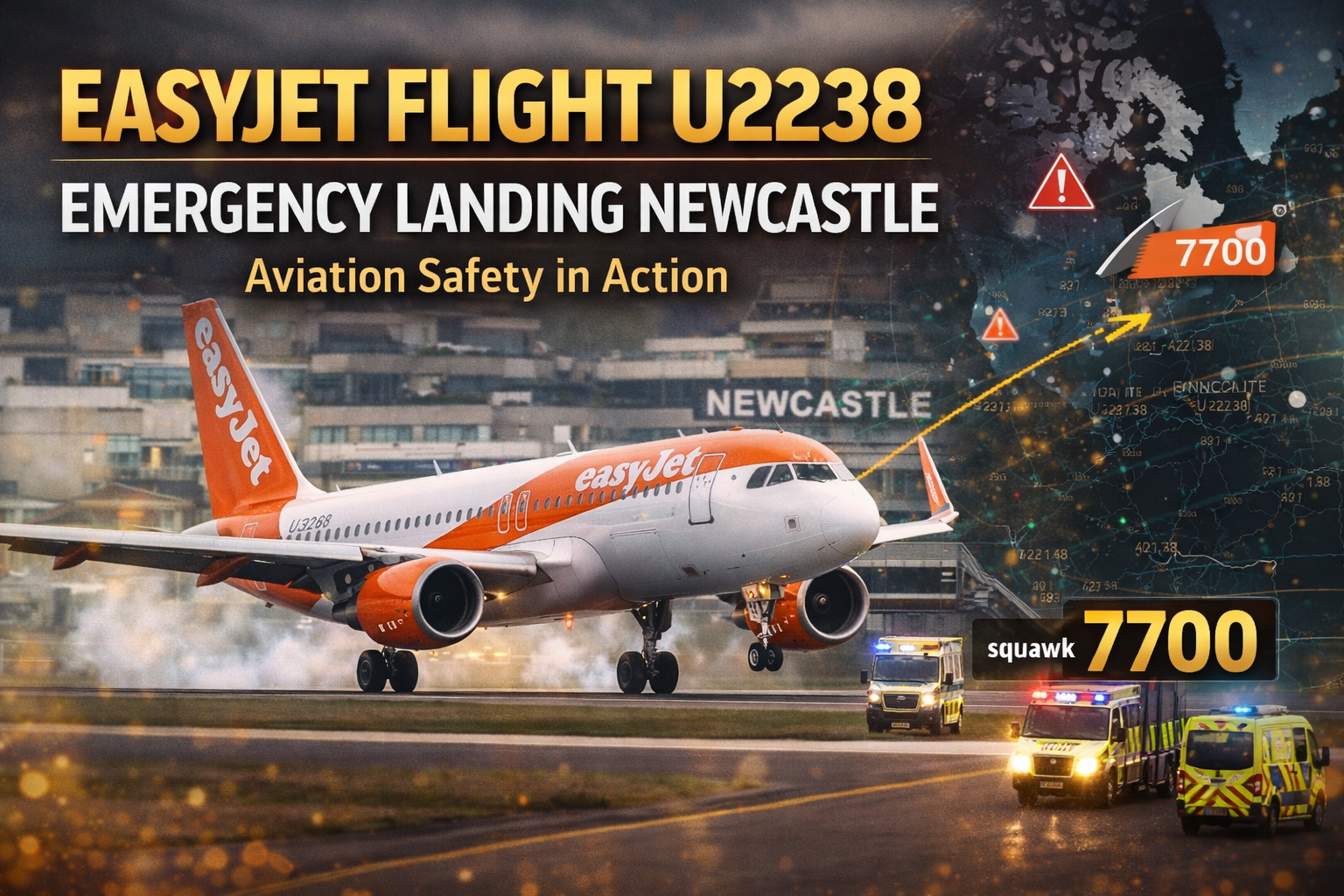
In October 2025, a routine EasyJet flight U2238 from Copenhagen to Manchester became the subject of widespread attention after the aircraft made an unplanned landing at Newcastle International Airport. The cause was not mechanical failure, pilot error, or dangerous weather — it was a passenger in medical distress, and the response from the flight crew, air traffic controllers, and airport emergency services was swift, coordinated, and professional from start to finish.
The incident involving flight U2238, operated on an Airbus A320, offered the travelling public a rare and reassuring glimpse into the layers of safety infrastructure that underpin every commercial flight. Far from a story of near-disaster, this is a story of systems working exactly as they were designed to.
The Flight: Copenhagen to Manchester
Flight U2238 departed Copenhagen Airport under normal conditions, climbing to cruising altitude and tracking southwest across northern European airspace toward Manchester. For passengers onboard, it would have appeared to be an entirely unremarkable short-haul journey — the kind EasyJet operates hundreds of times daily across the continent.
That changed when a passenger fell seriously ill during the cruise phase of the flight.
Cabin crew, trained to recognise and manage medical emergencies, assessed the situation quickly and escalated to the cockpit. The flight crew’s conclusion was unambiguous: this passenger needed ground-based medical attention as soon as possible, and continuing to Manchester was not an acceptable option.
The diversion decision was made.
Why Newcastle? Understanding Diversion Protocols
One of the most frequently asked questions following the incident was why the aircraft landed at Newcastle rather than pressing on to its scheduled destination of Manchester. The answer lies in the strict diversion protocols that govern commercial aviation worldwide.
When a pilot determines that a diversion is necessary — whether for medical, mechanical, or meteorological reasons — the choice of alternate airport is not arbitrary. Crews and controllers evaluate several factors simultaneously:
- Proximity — which suitable airport can be reached most quickly
- Runway capacity and length — whether the airport can safely handle the aircraft type
- Air traffic congestion — whether the airspace above the airport allows for immediate approach
- Weather conditions — visibility, wind, and surface conditions at the alternate
- Emergency response capability — whether the airport can have medical teams in position upon arrival
In the case of flight U2238, Newcastle International Airport represented the optimal choice across all of these criteria. It was the nearest appropriate airport, capable of accommodating the Airbus A320, and — critically — its emergency services could be mobilised and standing by on the apron before the aircraft had even begun its final approach.
Every minute saved in the diversion decision is a minute gained for the passenger in distress. Newcastle gave the crew that time advantage.
The Medical Emergency Onboard: What Happens in the Cabin
Airlines are bound by strict patient confidentiality obligations and rarely disclose the specific medical details of passenger incidents. What was confirmed in this case is that the emergency was serious enough to warrant an immediate diversion — a threshold that airline crews are trained to apply conservatively.
Commercial aircraft are far better equipped for medical emergencies than most passengers realise. Standard onboard medical resources include:
- Emergency medical kits containing medications, airway management equipment, and basic diagnostic tools
- Supplemental oxygen systems for passengers experiencing respiratory distress
- Automated External Defibrillators (AEDs), which can deliver potentially life-saving electric shocks to patients in cardiac arrest
- Trained cabin crew who undergo regular first aid and medical emergency training as a condition of their certification
Beyond the physical equipment, airlines routinely have access to ground-based medical advisory services — teams of doctors and specialists who can be patched into the aircraft’s communications systems to assess a patient’s condition remotely and advise the crew on whether a diversion is medically necessary. These services remove much of the uncertainty from an already pressurised situation and provide a clinical basis for the pilot’s final decision.
In the case of U2238, the assessment pointed clearly in one direction: land now.
Code 7700: The Signal That Changes Everything
As the diversion was initiated, flight tracking services detected that the aircraft had activated transponder code 7700 — a universal aviation signal that immediately identifies an aircraft as being in a state of general emergency.
The transponder squawk system is one of aviation’s most elegant safety mechanisms. Every aircraft in controlled airspace broadcasts a four-digit code that identifies it to air traffic control radar. Standard codes are assigned routinely. But three codes carry special meaning recognised by every controller and system worldwide:
- 7700 — General emergency
- 7600 — Radio communications failure
- 7500 — Unlawful interference (hijacking)
The moment a pilot sets 7700, the response is immediate and automatic. Air traffic control gives the aircraft absolute priority. Surrounding traffic is rerouted or held. A direct path to the nearest suitable airport is cleared. Emergency services at the destination are alerted. And every controller who has the aircraft on their screen knows, without any voice communication needed, that this flight takes precedence over everything else in their sector.
It is worth emphasising what 7700 does not mean. It is not an indication of catastrophic structural failure or imminent disaster. It is a tool — a deliberate, standardised tool — for requesting priority handling. Pilots are trained and encouraged to use it whenever circumstances demand an expedited response, and doing so is a sign of professional competence, not panic. In the case of flight U2238, activating 7700 ensured that Newcastle Airport was ready and waiting long before the aircraft appeared on final approach.
A Minute-by-Minute Account of the Incident
Reconstructed from available flight tracking data and confirmed reporting, the sequence of events on flight U2238 unfolded as follows:
Departure — Copenhagen Airport Flight U2238 pushes back and departs Copenhagen on schedule. The aircraft climbs normally and settles into its cruise profile en route to Manchester.
Cruise Phase — Northern European Airspace The aircraft tracks southwest across UK-bound airspace. No anomalies are recorded with the aircraft’s systems.
Medical Emergency Identified A passenger falls seriously ill. Cabin crew assess the situation, administer available onboard medical care, and notify the flight deck.
Pilot Declares Emergency The captain activates transponder code 7700 and contacts air traffic control. Newcastle International Airport is identified as the nearest suitable diversion point.
Diversion Initiated Air traffic control clears the aircraft for an immediate approach to Newcastle. Surrounding traffic is rerouted. Newcastle Airport activates its emergency response protocol — ambulances and medical teams are positioned on the airfield.
Landing at Newcastle The Airbus A320 lands safely at Newcastle International Airport. Emergency responders board the aircraft promptly to reach the affected passenger.
Ground Response Medical personnel assess and treat the passenger. Airline staff manage and assist the remaining travellers onboard.
Onward Journey Following the completion of ground procedures and necessary checks, flight U2238 continues its journey to Manchester Airport, arriving delayed but without further incident.
The Aircraft: Why the Airbus A320 Matters
The aircraft at the centre of this incident, the Airbus A320, is one of the most thoroughly proven passenger jets in the history of commercial aviation. Since entering service in 1988, the A320 family has accumulated hundreds of millions of flight hours across thousands of aircraft operated by airlines on every continent.
Its significance to this story lies not in any dramatic intervention by the aircraft’s systems — the emergency was medical, not mechanical — but in the reliability and operational flexibility that the A320 provides to crews dealing with unexpected situations. Its fly-by-wire flight control system, redundant hydraulic and electrical architecture, and comprehensive avionics suite allow pilots to manage diversions and non-routine situations with a calm, systematic approach rather than under additional workload pressure.
No mechanical fault was identified with the aircraft before, during, or after the diversion. The A320 performed exactly as expected throughout.
What Happens After: Post-Landing Procedures at UK Airports
The safe arrival of a diverted aircraft at a UK airport triggers a well-rehearsed sequence of post-landing actions that most passengers never see.
At Newcastle International Airport, as at all UK commercial airports, emergency response teams — including ambulance crews, airport fire service units, and airline ground staff — are positioned before the aircraft touches down. The moment the aircraft stops, the response begins.
For a medically driven diversion like this one, the immediate priority is accessing the unwell passenger. Medical personnel board the aircraft without delay, assess the patient, and arrange transfer to hospital if required. Meanwhile, airline ground staff coordinate with the remaining passengers — offering information, rebooking assistance, and onward travel arrangements where needed.
On the regulatory side, the UK’s Civil Aviation Authority monitors all such events as part of its broader safety oversight remit. The Air Accidents Investigation Branch, which handles serious aviation incidents and accidents, is not typically involved in straightforward medical diversions unless there is evidence of an underlying operational or mechanical issue that warrants formal investigation. In the case of flight U2238, no such investigation was initiated.
What the Incident Tells Us About Modern Aviation Safety
The EasyJet Flight U2238 diversion is, in one sense, unremarkable — medical diversions happen with some regularity in commercial aviation, and the vast majority are handled with the same professionalism on display here. In another sense, however, that very ordinariness is the point.
Aviation’s extraordinary safety record is not the result of good luck. It is the product of decades of deliberate system design, regulatory discipline, crew training, and a culture that prioritises proactive risk management over reactive crisis response. The decision to divert flight U2238 before the situation deteriorated further was not heroic — it was procedural. And that is precisely why it worked.
For the travelling public, incidents like this one serve as a useful reminder that commercial aviation is built around multiple overlapping layers of protection. When one situation presents itself — a passenger in distress, an airspace conflict, a weather system — the layers activate in sequence, each reinforcing the others, until the aircraft and everyone aboard reaches safety.
Advice for Passengers: Understanding Diversions and Delays
For those onboard a diverted flight, the experience can be disorienting. An unexpected change of destination, an announcement from the cockpit that the plane is landing somewhere unplanned — these things understandably unsettle people. A few key points are worth bearing in mind:
Diversions are precautionary decisions, not emergencies of last resort. Pilots divert when they determine that continuing the planned route is not in the best interest of passengers or crew — not when a situation has already become critical.
The crew is trained for this. Cabin staff and pilots undergo regular emergency scenario training precisely so that they can respond to unexpected situations without confusion or delay. The calm you observe from airline staff during a diversion is not indifference — it is professionalism.
Airport emergency teams will be ready. When an aircraft declares an emergency and diverts, the destination airport knows in advance. Help is waiting when the doors open.
Your journey will continue. In the vast majority of medical diversions where no mechanical issue is involved, the aircraft resumes its journey after the situation on the ground is resolved. As was the case with flight U2238, Manchester was still the destination — just with a stop in Newcastle along the way.
Conclusion
The story of EasyJet Flight U2238 is ultimately one of reassurance. A passenger fell ill at altitude over northern England. Within minutes, a trained crew had assessed the situation, declared an emergency, coordinated with air traffic control, and was descending toward a waiting team of medical professionals. The landing was smooth. The passenger received care. The aircraft continued to Manchester.
It is a sequence that played out not because of exceptional luck or extraordinary heroism, but because the systems built to protect passengers in exactly this kind of situation worked as intended.
In an era when aviation incidents attract intense public scrutiny, often generating more alarm than the facts warrant, the U2238 diversion stands as a useful corrective — a reminder that when you board a commercial aircraft, you are placing yourself in the care of one of the most rigorously safety-engineered systems ever created by human beings.
That is a fact worth remembering at 35,000 feet.
Frequently Asked Questions
Q: Why did EasyJet Flight U2238 make an emergency landing?
The aircraft diverted because a passenger onboard experienced a serious medical emergency during the cruise phase of the flight. The flight crew, following standard aviation safety protocols, determined that the passenger required immediate ground-based medical attention and that continuing to the scheduled destination of Manchester was not appropriate. The diversion to Newcastle was a deliberate, precautionary decision made in the interest of passenger welfare — not an indication that the aircraft itself was in danger.
Q: Was there anything wrong with the plane mechanically?
No. No mechanical fault was identified with the Airbus A320 before, during, or after the diversion. The aircraft’s systems performed normally throughout the flight. The emergency was entirely medical in nature, relating to the condition of a passenger, and the aircraft remained fully airworthy at all times.
Q: What does squawk code 7700 mean, and how serious is it?
Squawk code 7700 is a universal aviation transponder signal used to indicate a general emergency. When a pilot activates this code, air traffic control immediately grants the aircraft absolute priority—clearing its path, rerouting surrounding traffic, and alerting emergency services at the destination airport. However, 7700 does not necessarily indicate that an aircraft is in catastrophic danger. It is a standardised tool for requesting priority handling, and pilots are trained to use it whenever a situation demands an expedited response. In the case of U2238, it ensured that Newcastle Airport had medical teams ready and waiting before the aircraft landed.
Q: Why did the plane land at Newcastle rather than continuing to Manchester?
In aviation, diversion decisions are governed by strict protocols that weigh several factors simultaneously: distance to the nearest suitable airport, runway availability, air traffic congestion, weather conditions, and — critically in this case — the emergency medical response capability of the alternate airport. Newcastle International Airport was identified as the closest appropriate airport that could be reached quickly and that could have medical professionals on the ground before the aircraft arrived. Continuing to Manchester would have added unnecessary time to the passenger’s wait for treatment.
Q: Did the flight eventually reach Manchester?
Yes. After the diverted aircraft landed at Newcastle, medical personnel boarded to assist the unwell passenger, and the necessary ground procedures were completed. The aircraft subsequently continued its journey to Manchester Airport, arriving delayed but without any further incidents.
Q: What medical equipment is carried on commercial flights?
Commercial aircraft are equipped with a range of medical resources that most passengers are unaware of. These typically include emergency medical kits containing medications and airway management tools, supplemental oxygen systems, Automated External Defibrillators (AEDs) capable of delivering potentially life-saving shocks in cardiac arrest cases, and trained cabin crew who hold first aid and medical emergency certifications. Airlines also have access to ground-based medical advisory services — teams of doctors who can communicate with the aircraft remotely to assess a patient’s condition and advise on whether a diversion is necessary.
Q: How are cabin crew trained to handle in-flight medical emergencies?
Cabin crew undergo regular and comprehensive medical emergency training as a mandatory part of their professional certification. This training covers patient assessment, cardiopulmonary resuscitation (CPR), use of the AED, oxygen administration, and coordination with pilots and ground medical services. They are also trained to communicate clearly with any medically qualified passengers who may be onboard and willing to assist. The goal of the training is to stabilise the patient and buy time until the aircraft can reach qualified ground-based medical care.
Q: Who regulates aviation safety in the United Kingdom?
Two principal bodies oversee aviation safety in the UK. The Civil Aviation Authority (CAA) is responsible for ongoing airline safety regulation, licensing, and operational oversight — essentially ensuring that airlines, aircraft, and crew meet the required standards day to day. The Air Accidents Investigation Branch (AAIB) handles the investigation of serious aviation incidents and accidents when they occur. For medical diversions like flight U2238, where no mechanical or operational failure is suspected, formal AAIB investigation is not typically required, though all such events are reported and tracked by the relevant parties.
Q: Is it common for commercial flights to divert for medical reasons?
Medical diversions are more common than most passengers might expect. With hundreds of thousands of commercial flights operating worldwide every day, carrying passengers of all ages and health conditions, in-flight medical incidents occur regularly. The vast majority are managed onboard without diversion, but when a crew assesses that a passenger’s condition requires ground-based intervention, diversion is the standard and expected response. The aviation industry’s ability to handle these situations smoothly is a testament to the depth of training, planning, and coordination built into commercial flight operations.
Q: Should passengers be worried when a flight diverts?
Not in the way that the word “emergency” might initially suggest. A diversion is, by definition, a proactive safety measure — it is the crew choosing to act before a situation becomes critical, not responding to a crisis that has already spiralled out of control. The crew of flight U2238 diverted because they judged it to be the safest course of action for everyone onboard. That judgment, exercised calmly and competently, is exactly what passengers should hope for from the people in charge of their flight.
For flight status updates and travel information, visit EasyJet’s official website. For aviation safety information in the UK, visit the Civil Aviation Authority at caa.co.uk.cross the world.
Also read more about: Fecife: The Rise of a Digital Concept in an Era of Platform Identity and Muštarda: Origins, Flavor Profile, Culinary Uses & Global Popularity Guide






4 thoughts on “EasyJet Flight U2238 Emergency Landing Newcastle—Full Incident Analysis”