M6 Walsall Birmingham Lanes Closure: Causes, Incidents, and How to Navigate the Disruption
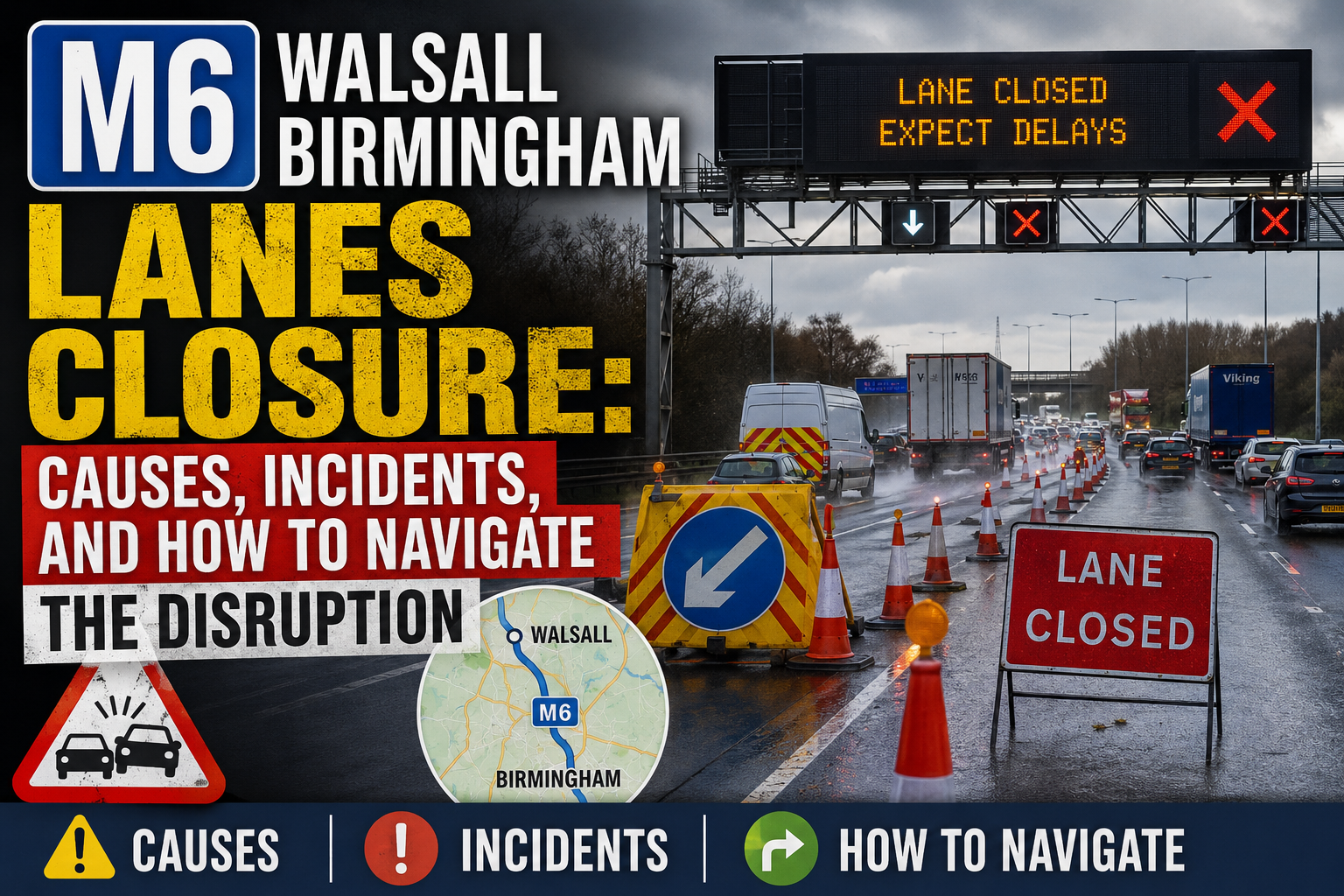
The M6 motorway is the backbone of England’s road network. Stretching from the West Midlands to the Scottish border, it carries an enormous volume of passenger vehicles, freight lorries, and commercial traffic every single day, connecting cities, sustaining supply chains, and enabling millions of daily commutes. In the Walsall and Birmingham corridor — one of the busiest and most congested stretches of any motorway in the country — lane closures are not occasional inconveniences. They are a persistent, recurring reality that costs commuters hours of lost time, disrupts businesses, and places growing pressure on the surrounding local road network.
From fatal collisions to broken-down HGVs, from overnight maintenance shutdowns to emergency weather closures, the causes of disruption on this stretch of the M6 are varied and relentless. On November 19, 2025 alone, a major multi-vehicle crash closed three lanes on the northbound carriageway and generated delays exceeding 90 minutes for thousands of motorists. It was not an exceptional day. It was, by the standards of this road, a typical one.
This article examines what drives closures on the M6 Walsall Birmingham corridor, documents the most significant recent incidents, explores the wider impact on commuters and commerce, and sets out practical strategies for drivers navigating one of the country’s most challenging stretches of motorway.
The M6 Walsall Birmingham Corridor: Why It Matters
The section of the M6 running through the West Midlands — broadly covering junctions 6 through 10a between Birmingham and Wolverhampton — sits at the heart of one of England’s most densely populated and industrially active regions. The Black Country, which the motorway bisects, is home to a major concentration of manufacturing, logistics, and distribution businesses. The road carries not just commuters but the freight movements that underpin the regional economy.
Junction 10, serving Walsall and Wolverhampton, is among the most heavily trafficked motorway interchanges in the Midlands. The proximity of the M5, M54, and M6 creates a complex web of merging and diverging traffic flows that amplifies the impact of any individual incident. When a collision closes two lanes near junction 9 or 10, the ripple effects spread across multiple motorways and dozens of miles of local roads within minutes.
Understanding this geography is essential context for everything that follows.
What Causes M6 Walsall Birmingham Lane Closures
Traffic Accidents and Collisions
Collisions are, by a significant margin, the most common cause of lane closures on the M6 Walsall Birmingham corridor. The high volume of mixed traffic — cars, motorcycles, vans, HGVs, and coaches all sharing the same carriageway at speed — creates constant exposure to accident risk, and when incidents occur at this scale of traffic density, the consequences are severe.
Recent incidents illustrate the pattern vividly. A fatal crash involving a lorry and a motorcycle near junction 10 forced the closure of the southbound carriageway, with all lanes remaining shut until 22:40 BST. The M54 eastbound between junction 1 and the M6 closed simultaneously, compounding the disruption across the wider network. A separate collision involving an overturned vehicle between junctions 4a and 5 resulted in three lane closures and delays of around 55 minutes. A man died after a silver Porsche 911 struck a barrier on the M6 northbound between junctions 6 and 7, triggering a closure that lasted more than five hours.
Multi-vehicle crashes near junction 9 in Wednesbury have repeatedly forced the closure of two out of three northbound lanes, creating backlogs extending for miles into the heart of the Black Country. Each of these incidents demands the attendance of emergency services, traffic officers, recovery vehicles, and in some cases specialist contractors — all of whom must operate safely within the live carriageway, requiring further lane closures and reduced speed limits that extend the duration of disruption well beyond the initial impact.
Vehicle Breakdowns Blocking Live Lanes
Breakdowns are a constant source of unplanned lane closures on this section of the M6, and their impact is disproportionate to their apparent severity. A single HGV stranded in a live lane on a three-lane motorway during the morning rush hour can reduce effective road capacity by a third, immediately creating a compression wave of slowing traffic that extends for miles behind the obstruction.
On February 28, one lane of three closed on the M6 northbound near junction 8 for West Bromwich following a vehicle breakdown, with normal conditions not restored until between 3:15pm and 3:30pm. On March 6, a breakdown on the hard shoulder between junctions 6 and 7 caused congestion that persisted until 9:30am — deep into the morning peak. A stranded lorry blocking a live lane in the Black Country caused significant delays for motorists across multiple junctions.
The problem is compounded on smart motorway sections where the hard shoulder has been converted to a running lane. Without a dedicated refuge for broken-down vehicles, a breakdown in the nearside lane forces an immediate closure response, with traffic officers needing to physically attend and manage the scene before recovery can begin.
Planned Roadworks and Maintenance
Not all M6 closures are unplanned. National Highways regularly schedules overnight maintenance windows to carry out essential work on the motorway’s ageing infrastructure — resurfacing, bridge repairs, drainage improvements, and safety barrier replacement. These closures are planned specifically for overnight periods to minimise impact on daytime traffic, but they still generate disruption, particularly for night-shift workers, freight operators, and early morning commuters.
National Highways has implemented overnight closures on the M6 northbound between junction 7 at Great Barr and junction 10 for Walsall and Wolverhampton, typically running from 21:00 GMT on Sundays through to 06:00 on Monday mornings. Work on the Bescot viaduct — a significant structure on this stretch of the motorway — has included resurfacing and joint repairs scheduled primarily at night.
Planned works are announced in advance and listed on the National Highways website, giving drivers the opportunity to plan around them. In practice, however, awareness of overnight closure schedules remains low among many regular motorists.
Weather and Emergency Conditions
Severe weather — ice, heavy snow, high winds, or flooding — periodically forces authorities to implement emergency closures when driving conditions on the motorway become actively dangerous. These events are less frequent than accident or breakdown-driven closures but tend to affect larger sections of the carriageway simultaneously and can persist for extended periods while conditions are assessed and treated.
Recent Incidents: A Chronicle of Disruption
November 2025: Multi-Vehicle Crashes Close Three Lanes
November 2025 brought some of the most severe disruption the M6 Walsall Birmingham corridor had seen in months. A multi-vehicle collision on the M6 southbound between junctions 10a and 10 occurred shortly before midday, closing two lanes for more than half an hour. Emergency services managed the scene while motorists faced delays of up to 40 minutes, with queues building rapidly in both directions. National Highways West Midlands confirmed that residual delays of at least 20 minutes persisted for some time after the scene was cleared.
On the northbound carriageway, a separate multi-vehicle collision between junctions 9 and 10 prompted road closures as West Midlands Police sealed off the area to allow vehicle recovery. Traffic congestion extended approximately two miles on approach, with the impact felt across connecting routes and local roads throughout the Black Country.
Junction 10: The 90-Minute Bottleneck
Junction 10 has become something of a recurring focal point for severe disruption. A crash involving two cars and a van between junctions 8 and 9 generated delays exceeding 90 minutes, with three of four lanes closed for vehicle recovery and approximately seven miles of congestion affecting both the M6 and M5 north.
A subsequent collision between junctions 10 and 10a — the interchange with the M54 — closed two of four lanes on a Tuesday afternoon and produced delays of 90 minutes with around nine miles of queuing traffic. For the tens of thousands of drivers who use this junction daily to travel between Wolverhampton, Walsall, and the wider Midlands motorway network, these incidents represent hours of lost time and significant economic cost.
March 2026: The HGV Load Spillage
One of the most unusual and disruptive incidents on record for this stretch of motorway occurred in the early hours of March 4, 2026, when an HGV split its load of offal across the carriageway between junctions 14 and 15, near Stafford and Stoke-on-Trent. The incident occurred at approximately 05:30, closing three lanes at the worst possible moment — precisely when freight traffic is heaviest and the road is being used by early-shift commuters.
Specialist contractors were required to safely handle and clear the material from the carriageway, a process that proved time-consuming and technically demanding. Severe delays of up to two hours resulted, with very heavy congestion extending for up to nine miles between junctions 13 and 15. The incident served as a stark illustration of how an apparently mundane mechanical failure on a single vehicle can cascade into hours of disruption affecting hundreds of thousands of people.
The Wider Impact: Who Bears the Cost of M6 Disruption?
Commuters: Time Lost and Stress Gained
The most immediate and personal impact of M6 lane closures falls on individual commuters. Lane reductions force vehicles to merge into fewer streams of traffic, rapidly compressing road capacity and creating the stop-start congestion that characterises major motorway incidents. A journey that typically takes 20 to 30 minutes along this corridor can expand to an hour or more during a significant closure, and delays exceeding 90 minutes are not uncommon during serious incidents.
The cumulative effect on daily life is substantial. Missed appointments, late arrivals at work, disrupted childcare arrangements, and the physical and psychological stress of prolonged stop-start driving all contribute to a quality-of-life toll that official delay statistics rarely capture fully. For shift workers, healthcare staff, and others who cannot absorb flexible start times, even a 30-minute delay can have serious professional consequences.
Freight and Logistics: A Chain Reaction
The M6 Walsall Birmingham corridor is a critical artery for the UK freight industry. Haulage companies operating across the Black Country and wider Midlands rely on predictable journey times to honour delivery schedules, manage driver hours, and control operating costs. Lane closures disrupt all three.
Congestion drives up fuel costs as vehicles idle in queues. Delays push drivers toward the legal limits of their working hours regulations, potentially preventing them from completing planned routes. Delivery windows are missed. Perishable goods face risk. Customers experience supply disruptions. For logistics businesses already operating on tight margins, a single major incident on the M6 can translate directly into financial loss.
Public transport operators and coach companies face similar pressures, with scheduled services unable to guarantee arrival times when the motorway is subject to severe delay.
Emergency Services: Response Times Under Pressure
A consequence of M6 congestion that receives less public attention than it deserves is the impact on emergency service response times. When large sections of the motorway are gridlocked, ambulances, fire engines, and police vehicles attempting to reach incidents — whether on the motorway itself or in communities whose access roads are clogged with diverted traffic — face delays that can have life-or-death consequences.
The problem is compounded by driver behaviour during closures. As motorists make sudden lane changes to position themselves for exits or navigate around cones and closures, the risk of secondary accidents increases. These incidents, occurring in already-congested conditions, create additional obstacles for emergency responders and extend the overall duration of disruption.
Local Communities: The Overflow Effect
When the M6 grinds to a halt, drivers do not simply sit and wait. Many exit the motorway at the nearest junction and attempt to navigate around the blockage using local roads — roads that are not designed to absorb the volume of traffic that a major motorway closure displaces.
The A6, running broadly parallel to affected M6 sections, experiences particularly heavy congestion during motorway closures. Communities north of Preston, including Garstang, Galgate, and Lancaster, experience heavier-than-usual traffic as displaced motorway users seek alternative routes. Residential streets, school-run routes, and town centre junctions all absorb pressure that their design never anticipated. Local bus services slow. Junctions back up. The disruption radiates outward from the motorway in concentric rings, affecting people and places that never set foot on the M6.
How to Navigate M6 Walsall Birmingham Closures
Check Live Traffic Updates Before You Leave
The single most effective thing any driver can do to avoid M6 disruption is to check live traffic conditions before departure rather than discovering problems once already on the motorway. National Highways operates the Traffic England website and maintains a daily closures page listing all planned works and known incidents across the network. Checking these sources before a journey takes minutes and can save hours.
The RAC Route Planner similarly allows drivers to identify current M6 closures and check conditions along their planned route before and during a journey. Most modern smartphones will surface live traffic alerts automatically if navigation is active, but actively checking a dedicated source before leaving home provides an additional layer of advance warning.
Use the A34 and M5 as Alternatives
For drivers caught in or seeking to avoid congestion in the junction 7 to 10 corridor, the A34 provides the primary alternative surface road route between Birmingham and Walsall. Junction 7 connects the M6 directly to the A34, offering an exit point before the most congested section of the motorway.
A specific technique worth knowing for congestion near junction 8: drivers can exit at junction 7, use the A34 northbound, and re-enter the M6 at junction 8 via the opposite clear slip road — a manoeuvre that can save between five and ten minutes during peak rush-hour congestion without adding significant distance to the journey.
The M5 serves as an alternative for longer-distance journeys that can tolerate a wider diversion, particularly for traffic heading north or west of the Birmingham conurbation.
Use Smart Navigation Apps
Real-time navigation applications have transformed the experience of driving on congested roads. Waze collates live incident reports submitted by other drivers, providing rapid awareness of accidents, breakdowns, and lane closures that may not yet appear on official sources. Google Maps uses a combination of live GPS data, historical traffic patterns, and predictive modelling to suggest alternative routes automatically and update guidance as conditions change.
Both applications provide lane-level guidance on motorways, which is particularly useful in the approach to complex interchanges like junction 10. Used proactively — with alerts enabled and applications running from the start of a journey — these tools provide a meaningful advantage over driving blind into a closure.
Build in Extra Time During Peak Hours
For regular users of the M6 Walsall Birmingham corridor, particularly those with non-negotiable arrival times, the most reliable mitigation strategy is simply to build extra time into every journey during peak periods. The morning rush hour — roughly 07:00 to 09:30 — and the afternoon peak — approximately 16:00 to 19:00 — are when the consequences of any incident are most severe. Leaving earlier or later than these windows, where circumstances allow, substantially reduces exposure to the worst delays.
Observe Temporary Speed Limits and Signage
Research on managed motorway interventions consistently shows that graduated speed limit reductions are more effective at smoothing traffic flow than abrupt changes. When variable speed limit signs on the M6 display reduced limits ahead of a closure or incident, compliance with those limits helps maintain momentum and reduces the severity of the compression wave that builds behind an obstruction. Ignoring temporary speed limits not only risks a fixed penalty but actively worsens the congestion that every driver in the queue is trying to escape.
Conclusion
The M6 Walsall Birmingham corridor is one of the most important and most pressurised stretches of motorway in England, and the frequency of lane closures and associated delays is a direct reflection of the volume and variety of demands placed upon it. Accidents, breakdowns, planned maintenance, and occasional weather events all contribute to a pattern of disruption that affects hundreds of thousands of drivers, freight operators, and communities every week.
There is no simple fix. The underlying causes — high traffic density, ageing infrastructure, the unpredictability of human behaviour on the road — cannot be eliminated. What can be managed is the individual driver’s response: checking conditions before departure, knowing the alternative routes, using the technology available, and building realistic journey times that account for a road where delay is not the exception but the norm.
For those who travel the M6 through Walsall and Birmingham regularly, that preparation is not optional. It is the price of using one of the country’s most essential, and most demanding, roads.
Frequently Asked Questions
Q: Which part of the M6 is most prone to congestion and lane closures near Walsall and Birmingham?
The most heavily affected section is broadly between junctions 6 and 10a in the West Midlands. Junction 10, serving Walsall and the interchange with the M54 toward Wolverhampton, is a particularly persistent hotspot for both accidents and breakdown-related closures. The interaction of the M6, M5, and M54 in this area creates complex merging traffic that amplifies the impact of any individual incident. The corridor between junctions 8 and 10 has seen some of the most severe delays in recent months, including multiple incidents generating 90-minute queues and congestion extending seven to nine miles.
Q: What are the most common causes of M6 lane closures on this stretch?
Lane closures on the M6 Walsall Birmingham corridor arise from four primary causes. Traffic accidents and multi-vehicle collisions are the most frequent trigger, ranging from minor shunts that briefly reduce capacity to fatal crashes requiring closures lasting many hours. Vehicle breakdowns — particularly HGVs stranded in live lanes — are the second most common cause, with disproportionate impact during morning and evening peak periods. Planned roadworks and maintenance account for a predictable share of overnight closures. Severe weather conditions occasionally force emergency lane or full carriageway closures when driving becomes actively hazardous.
Q: How long do delays typically last during M6 closures near Walsall?
Delay duration varies significantly with the nature and severity of the incident. Minor breakdowns that can be resolved quickly may cause delays of 20 to 40 minutes. Serious multi-vehicle collisions involving HGVs, requiring specialist recovery and, in fatal incidents, police investigation and scene preservation, can close lanes for five hours or more and generate delays exceeding 90 minutes with queues stretching for miles. The March 2026 HGV load spillage between junctions 14 and 15 produced delays of up to two hours across a nine-mile stretch — an illustration of how unusual incidents can generate exceptional disruption even in the absence of a collision.
Q: What alternative routes should drivers use when the M6 is closed near Birmingham or Walsall?
The A34 is the primary alternative surface route between Birmingham and Walsall. Junction 7 connects directly to the A34, providing an exit before the most congested section of the motorway. For congestion near junction 8 specifically, a useful technique is to exit at junction 7, travel the A34 northbound, and re-enter the M6 at junction 8 via the opposite slip road — a manoeuvre that can save five to ten minutes during rush hour. The M5 serves as a broader alternative for longer journeys heading north or west. Navigation apps such as Waze and Google Maps will suggest live alternative routing based on current conditions across the network.
Q: How can I find out about M6 closures and incidents before I travel?
National Highways operates the Traffic England website, which provides live incident information and a daily closures page listing all planned works across the network. Checking this resource before departure is the most reliable way to identify known closures in advance. The RAC Route Planner also incorporates live traffic data and allows drivers to check conditions along a specific planned route. For real-time alerts during a journey, Waze and Google Maps are the most widely used and effective tools, offering automatic rerouting based on live conditions reported by other drivers and traffic sensors.
Q: Do M6 closures near Walsall affect surrounding local roads?
Significantly, yes. When the M6 experiences major closures, large volumes of traffic divert onto local roads that are not designed to handle motorway-level volumes. The A6, which runs broadly parallel to affected sections, experiences particularly heavy congestion. Communities surrounding the motorway — including residential areas, town centres, and school-run routes — absorb a surge of diverted vehicles that causes queuing at junctions and slows local bus services. The impact is felt well beyond the motorway itself, affecting people who never intended to travel on it.
Q: Why do lorry incidents seem particularly disruptive on this stretch of the M6?
HGVs cause disproportionate disruption for several reasons. They occupy more physical road space than passenger vehicles, meaning a broken-down lorry in a live lane eliminates a larger proportion of usable carriageway width. They take longer to recover or remove, requiring specialist vehicles and, in the case of load spillage, specialist contractors.
When lorries are involved in collisions, the scale of damage — to the vehicle, any other vehicles involved, and sometimes the road surface or barrier — extends the time needed to clear the scene and restore full capacity. The March 2026 offal spillage incident, requiring specialist clean-up contractors and closing three lanes for hours at the morning freight peak, is a particularly vivid example of how a single lorry-related incident can generate cascading regional disruption.
Q: What impact do M6 lane closures have on freight and business operations in the region?
The economic impact is substantial. Haulage companies operating in the Black Country and wider Midlands depend on predictable journey times to meet delivery schedules, manage driver hours in compliance with legal working time limits, and control fuel and operational costs. Lane closures disrupt all three simultaneously. Missed delivery windows, idle fuel burn in queues, and compliance pressure on driver hours regulations translate directly into financial cost for logistics operators.
Businesses reliant on just-in-time supply chains face production disruption when deliveries are delayed. Coaches and public transport operators cannot guarantee scheduled arrival times, affecting passengers and generating complaints and compensation claims. The cumulative regional cost of regular M6 disruption runs to many millions of pounds annually.
Q: Is the M6 near Walsall a smart motorway? Does that affect how closures are managed?
Several sections of the M6 in the West Midlands have been converted to smart motorway operation, where the hard shoulder is used as a running lane during peak periods and variable speed limits are managed dynamically by overhead gantry signs. This configuration increases capacity during normal operations but changes the dynamics of breakdown management.
Without a permanent hard shoulder as a refuge, broken-down vehicles in the nearside lane require an immediate lane closure response until traffic officers can attend. National Highways and the Government have faced significant scrutiny over smart motorway safety, and ongoing reviews have influenced policy on hard shoulder restoration on some sections of the network.
Also read more about: EasyJet Flight U2238 Emergency Landing Newcastle—Full Incident Analysis
gd7 playz.blogspot/2025/03/rbs.html Explained – Complete GD7 Playz RBS Article Analysis
MobilesRus: The Modern Hub for Smartphones, Accessories, and Digital Mobile Solutions
StreamEast: The Complete Guide to the Free Sports Streaming Platform (2026)