Glasgow Water Main Break Shettleston Road 2026
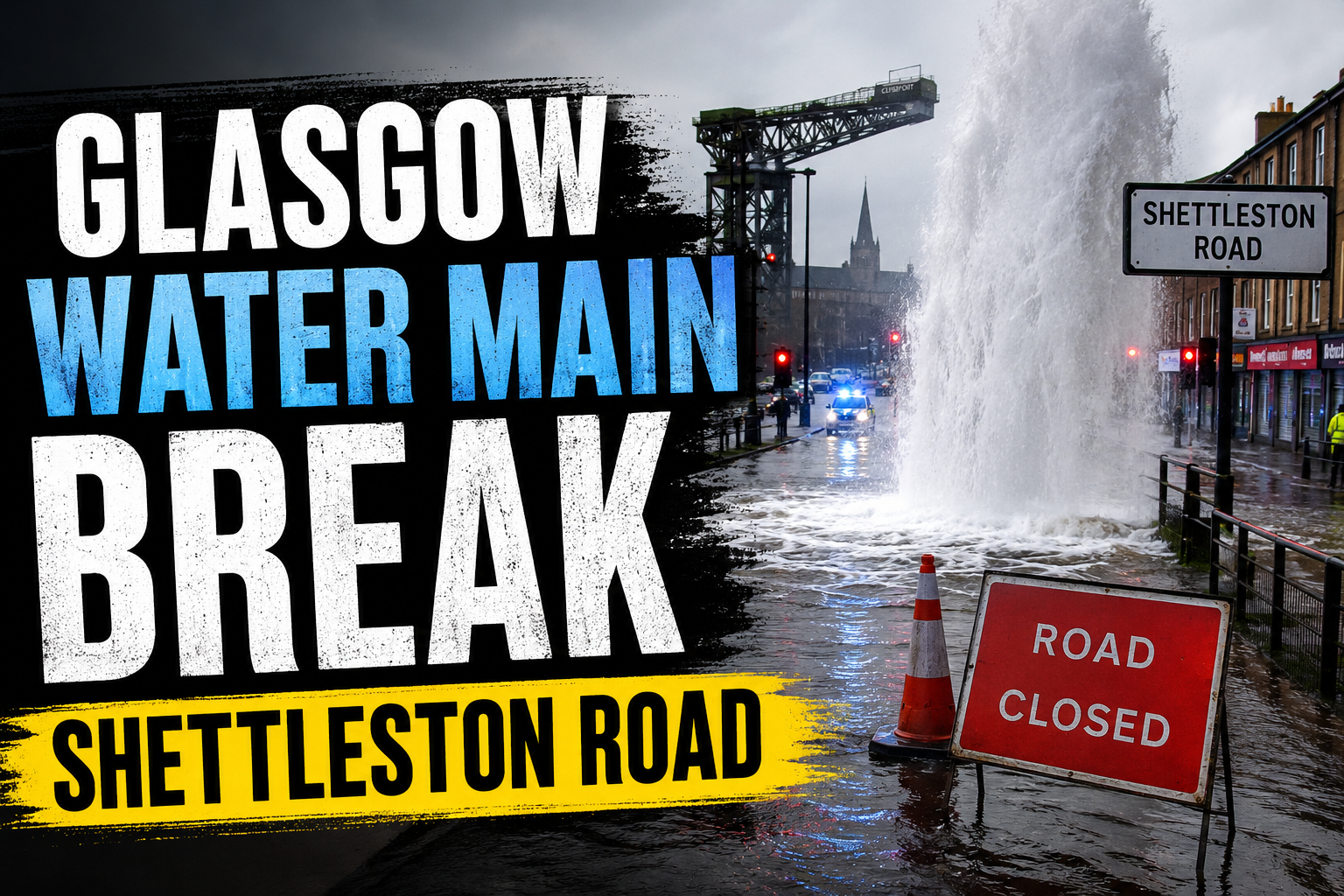
On the morning of May 29, 2025, a catastrophic water main failure beneath Shettleston Road sent torrents of water surging across one of Glasgow’s busiest thoroughfares. The incident plunged the entire G32 postcode into crisis — cutting off water supply, paralyzing traffic, shutting down businesses, and forcing hundreds of residents to cope without running water for the better part of a day. The event exposed the deep fragility of aging underground infrastructure in the city and raised urgent questions about when — and how — Glasgow will invest in the pipes that underpin daily life.
What Happened: A Timeline of the Emergency
8:30 AM — The First Signs of Failure
The morning rush hour had barely begun when residents along Shettleston Road heard it first: a sharp cracking sound coming from beneath the street. Within minutes, water began forcing its way through fissures in the road surface near the junction with St Mark Street, rapidly spreading across the carriageway and surrounding pavements. What started as an unusual wet patch quickly became an uncontrolled flood.
Scottish Water crews were alerted immediately and arrived on scene as rush-hour traffic was building. What they found was a significant rupture in one of the main underground water pipes serving the East End of Glasgow — and it was worse than initial assessments had suggested.
Immediate Road Closures and Emergency Response
Authorities moved swiftly to protect public safety. The junction of Shettleston Road at Hart Street was closed, with Glasgow City Council deploying road barriers and traffic cones around the growing flood zone. Motorists were urged to avoid the area entirely and seek alternative routes. Scottish Water simultaneously activated its emergency utility response protocol, dispatching engineers to assess the network and begin isolating the damaged section.
Heavy excavation machinery was brought in. As crews broke through the road surface, they discovered that the break was more extensive than first feared — a finding that would extend both the repair time and the scale of disruption for local residents and businesses.
Why Did the Pipe Fail? The Root Causes
Aging Infrastructure at Breaking Point
The Shettleston Road failure did not happen in isolation. It is part of a well-documented and growing crisis in urban water infrastructure across the United Kingdom. Cast iron pipes installed before the 1930s corrode from the inside out over decades, developing structural weaknesses that eventually give way under pressure. Estimates suggest that approximately one-fifth of water pipes in urban systems were laid before 1931, and nearly all of these will reach the end of their useful service lives within the next 15 years. These older mains are already responsible for close to half of all water main leaks nationally.
Cast iron, the dominant pipe material of that era, is considerably more brittle than modern alternatives such as ductile iron. When subjected to soil movement, pressure changes, or corrosive ground conditions, it fractures rather than flexes. The result is exactly what Shettleston Road experienced: a sudden, dramatic failure with little warning.
Weather and Ground Conditions
Temperature fluctuations in the weeks and months preceding a main break often play a decisive role. When the ground freezes, it expands and exerts enormous lateral pressure on buried pipes. The thaw period can be just as damaging: as temperatures rise, the soil shifts and contracts, stressing already-weakened pipe joints and connections. Pipes that have survived a hard winter intact can crack days or weeks later as the ground warms.
Increased rainfall and soil saturation add further stress, placing additional load on buried pipelines and destabilizing the ground around them.
Construction and Ground Disturbance
Urban environments are constantly being dug up — for new utilities, building foundations, road improvements, and telecoms infrastructure. Each nearby excavation carries the risk of disturbing or dislodging older pipes that were never designed to tolerate repeated ground disturbance. Uneven soil compaction from construction activity can place localised pressure on pipe walls, accelerating the kind of structural fatigue that ultimately leads to failure.
The Human Impact: Residents, Businesses, and Commuters
Hundreds of Homes Left Without Water
Scottish Water confirmed that the break affected a wide geographic area, including the Shettleston, Carmyle, Tollcross, and Mount Vernon neighbourhoods — the full G32 postcode. The experience varied from home to home: some residents lost water pressure entirely, others experienced heavily reduced flow, and many reported discoloured water coming from their taps. Everyday tasks — cooking, washing, hygiene — became unexpectedly difficult. Families were advised to store water, minimise usage, and follow any boil-water guidance until the supply was confirmed safe.
Businesses Forced to Shut Their Doors
The commercial impact was immediate and significant. Cafés, restaurants, hair salons, launderettes, and healthcare providers — all heavily reliant on a constant water supply — faced the choice of closing or operating in a severely reduced capacity. Many opted to shut entirely. Road closures compounded the problem: with large sections of Shettleston Road blocked off, foot traffic collapsed, hitting nearby shops and eateries regardless of whether they had water.
The combination of lost revenue and reduced custom represented a painful day for small businesses in an area that can ill afford prolonged economic disruption.
Traffic Chaos Across the East End
The road closures sent shockwaves through Glasgow’s East End transport network. Large sections of Shettleston Road — a major corridor connecting communities east of the city centre — were sealed off while repair crews worked. Vehicles were rerouted through residential side streets, many of which were not designed to handle the volume of traffic that was diverted through them.
Several First Bus Glasgow services, including routes 2, 46, and 60, were redirected along alternate roads, adding significant time to commuter journeys. For those travelling through the East End during the morning and afternoon peaks, the delays were considerable.
A Community Pulls Together
Amid the disruption, residents demonstrated the kind of resilience that characterises tight-knit urban communities. Neighbours shared bottled water with those who had none. Local groups coordinated online to flag where supplies were available and which roads remained passable. Businesses that were able to trade adapted quickly, and many returned to full operation as soon as water service was restored.
The Repair Operation
Isolating the Break
Scottish Water’s engineers began by closing the necessary valves to cut off the supply of water to the broken section, halting the outflow and preventing further flooding. Valves were closed gradually to avoid abrupt pressure changes elsewhere in the network, which can cause further damage downstream. As the isolation process progressed, the affected area initially widened before engineers narrowed down the fault location precisely enough to restore supply to as much of the surrounding network as possible.
Excavation and Replacement
With the pipe isolated, crews set about opening the road surface. Water mains typically sit between three and ten feet underground, and the work of excavating safely — particularly in an urban environment with multiple utilities running in close proximity — requires care and precision. Pumps were used to clear the water pooled around the damaged section before the main itself could be accessed.
Once the pipe was exposed, engineers determined that the damaged section required replacement rather than patching. The new pipe was installed, connected to the existing network, and pressure-tested before the repair zone was sealed.
Water Quality Testing and Restoration
Following the physical repair, the restored main underwent disinfection and rigorous water quality testing before service was returned to customers. Nearby hydrants were opened to flush air, debris, and any residual contamination from the system. Valves were carefully reopened to rebuild pressure gradually and evenly across the network. Only once testing confirmed the water met safety standards were customer connections restored and households notified that supply had returned to normal.
The full repair process, from isolation to restoration, was completed within the 8-to-12-hour window that Scottish Water typically targets for major main breaks.
The Bigger Picture: Glasgow’s Infrastructure Challenge
The Shettleston Road incident is a symptom of a far larger and longer-running problem. Glasgow, like many post-industrial British cities, built much of its water infrastructure in the Victorian and Edwardian eras. Those pipes — laid when the city was among the fastest-growing in the world — are now approaching, or have already exceeded, the limits of their design lives.
The mathematics are stark: with roughly half of all water main failures attributable to pre-1931 pipes, and with most of those pipes expected to fail within the next decade and a half, the frequency of events like the Shettleston Road break is only likely to increase unless significant investment in pipe replacement is accelerated.
Scottish Water has committed to ongoing infrastructure renewal programmes, but the scale of the challenge is immense. Urban pipe replacement is expensive, disruptive, and slow. Each section of main that is replaced requires closing roads, rerouting traffic, and managing the risk of disturbing other buried services — the very conditions that cause so much disruption when a pipe fails unplanned.
The question is whether a sustained, proactive programme of renewal can outpace the rate of deterioration. The answer, in cities like Glasgow, is not yet clear.
Conclusion
The Glasgow water main break on Shettleston Road on May 29, 2025, was more than a local inconvenience. It was a vivid illustration of what happens when aging infrastructure reaches its limits in a densely populated urban environment: water in the streets, homes without supply, businesses shuttered, and an entire community’s daily routine thrown into disarray.
Scottish Water’s response was efficient, and service was restored within the expected timeframe. The community, for its part, responded with characteristic resilience. But the underlying problem — miles of deteriorating cast iron pipe running beneath Glasgow’s streets — remains. Without sustained investment and a credible long-term renewal strategy, days like this one on Shettleston Road will become an increasingly familiar feature of urban life in the city.
Also read more about: CNLawBlog: Your Complete Guide to Understanding Chinese Law, Policy, and Legal Practice