Delta Flight DL275 Diverted to LAX: Full Incident Report & Timeline (2026)
Introduction: A Routine Flight That Wasn’t
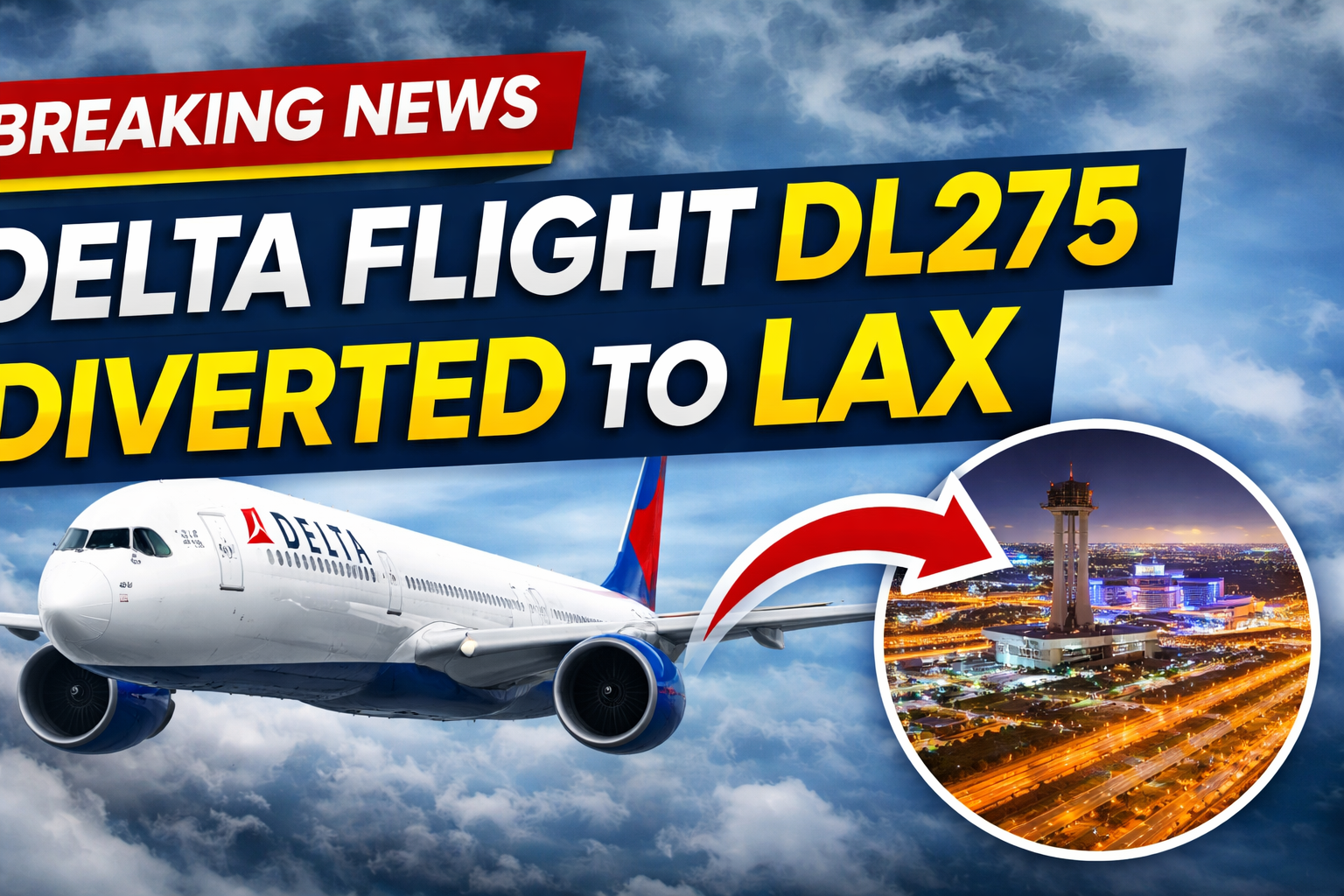
On May 27, 2025, what began as a routine 13-hour trans-Pacific journey from Detroit to Tokyo ended unexpectedly on the tarmac at Los Angeles International Airport. Delta Air Lines Flight DL275 — a daily long-haul service operated by an Airbus A350-900 — was forced to divert mid-flight after the flight crew detected a critical technical malfunction over one of the most remote stretches of ocean on the planet.
All 287 passengers landed safely at LAX. There were no injuries. But the incident sent ripples through the aviation community, sparked widespread concern among travelers, and served as a vivid reminder of the split-second decision-making that modern commercial aviation demands.
This is the complete story of what happened, why it happened, how it was handled — and what it means for passengers, aviation safety, and long-haul flying.
Flight DL275: Background and Route Overview
Delta Flight DL275 is one of Delta Air Lines’ core trans-Pacific operations, connecting Detroit Metropolitan Wayne County Airport (DTW) with Tokyo Haneda Airport (HND) on a daily schedule.
Key Flight Details
| Detail | Information |
|---|---|
| Flight Number | Delta DL275 / DAL275 |
| Route | Detroit (DTW) → Tokyo Haneda (HND) |
| Distance | Approximately 6,200 miles |
| Scheduled Duration | ~13 hours |
| Aircraft | Airbus A350-900 |
| Registration | N508DN |
| Engine Type | Rolls-Royce Trent XWB |
| Passenger Capacity | ~287 passengers |
| Departure Gate | Gate A46, Detroit |
The Airbus A350-900 is one of the most advanced long-range commercial aircraft in service today, designed specifically for demanding trans-oceanic routes. It is widely regarded as highly reliable, fuel-efficient, and passenger-friendly — making the diversion all the more unexpected for those on board.
Timeline of Events: From Departure to Diversion
Departure — Detroit, May 26, 2025
Flight DL275 departed Detroit Metropolitan Wayne County Airport from Gate A46 on the evening of May 26, 2025. The aircraft — Airbus A350-900, tail number N508DN — climbed to cruising altitude and set its course northwest, over Canada, toward the vast and remote expanse of the North Pacific.
For the first several hours, everything proceeded normally. Passengers settled in, meals were served, and the aircraft tracked its planned route toward Tokyo Haneda.
Mid-Flight — Over the Bering Sea
Hours into the journey, while the aircraft was cruising at approximately 38,000 feet over the Bering Sea — one of the most remote regions on any commercial flight path — the cockpit crew began receiving abnormal sensor readings. During cruise, the flight crew noticed abnormal behavior in the anti-ice system of one engine while the aircraft was roughly 620 nautical miles southwest of Anchorage, Alaska.
This placed the aircraft deep in remote oceanic airspace — far beyond easy reach of most diversion airports. The crew initiated diagnostic procedures immediately.
The Decision to Divert
When it became clear during the assessment that the issue could not be resolved in flight and that continued operation without a fully functioning anti-ice system over remote oceanic airspace could pose a risk, the pilots communicated with Delta’s operations control and requested a diversion.
The decision, while disruptive, was non-negotiable under commercial aviation safety regulations. The flight had departed Detroit gate A46 for a 13-hour flight to Tokyo Haneda Airport, but while flying over the Bering Sea, the crew decided to turn around.
Five Hours to LAX
Rather than heading to the nearest airport — which geographically would have been Anchorage — the crew and Delta Operations Control selected Los Angeles International Airport (LAX) as the diversion destination. The aircraft flew for an additional five hours to reach the California coast.
The Airbus A350-900, with registration N508DN, flew for five hours to reach Los Angeles Airport, landing on runway 06R. The aircraft touched down at 1:38 AM local time.
Safe Landing at LAX
Emergency services at LAX were placed on standby prior to arrival. The landing was smooth, completed without incident, and all 287 passengers disembarked safely. Delta ground staff were positioned and ready to assist immediately upon arrival.
The Technical Cause: What Is an Engine Anti-Ice System?
Why This System Is Critical
The anti-ice system prevents dangerous ice buildup on parts of the Rolls-Royce Trent XWB engines. At high altitudes over cold regions — such as the North Pacific and Bering Sea — ice can form even in clear skies, and the system keeps engine surfaces warm to counter this.
To understand why this malfunction triggered an immediate diversion, it helps to understand exactly what’s at stake when this system fails.
How Ice Forms at Altitude
At cruising altitude over the North Pacific, outside air temperatures routinely fall below -60°F (-51°C). Despite seemingly clear conditions, moisture particles in the atmosphere can crystallize on contact with cold engine surfaces — including the engine cowling and leading edges.
Without active anti-icing, the risks include:
- Disrupted airflow into the engine, reducing thrust and efficiency
- Engine stall or surge, potentially causing catastrophic power loss
- Sensor interference, producing false readings that complicate pilot decision-making
- Structural ice accumulation, increasing weight and altering aerodynamics
Why the Crew Could Not Continue
The system did not fail catastrophically but showed enough irregular behavior that it could not be conclusively certified as fully operational during the remainder of the long haul. Over remote oceanic airspace with no nearby diversion options, any uncertainty about a critical safety system is treated as an unacceptable risk under international aviation regulations.
The confirmed cause behind Delta Flight DL275 diverted to LAX was a technical malfunction in the engine anti-ice system — a critical safety component on one Rolls-Royce Trent XWB engine.
Why LAX? The Logic Behind the Diversion Airport
Many observers questioned why the crew flew an additional five hours to Los Angeles rather than diverting to a closer airport such as Anchorage. The answer is rooted in practical aviation logistics.
Delta Flight DL275 diverted to LAX specifically because LAX has routine Airbus A350 maintenance facilities available, the airport supports 24/7 Rolls-Royce engine specialist access for engines like the Trent XWB, and specialized tooling and parts inventories are available at this hub, minimizing the time needed to diagnose and repair the system.
Additionally, LAX is a major Delta hub, meaning the airline had full ground infrastructure in place — customs and immigration processing, passenger rebooking systems, hotel coordination, and customer service personnel — all available immediately upon landing.
Diverting to a smaller airport with limited maintenance capability would have left 287 passengers stranded in a location with far fewer resources to manage the disruption efficiently.
On Board: What Passengers Experienced
The Announcement
For passengers deep into what should have been a routine overnight flight, the announcement of a diversion was understandably alarming. The flight crew handled communication professionally — passengers were informed through announcements from the flight crew, which explained the situation calmly and assured passengers that safety procedures were being followed.
Flight attendants provided regular updates throughout the remaining five-hour flight to LAX, offering reassurance, refreshments, and answers to passenger questions where possible.
Arrival and Ground Handling
Upon landing at LAX, Delta’s ground teams moved quickly. Delta staff worked to assist travelers with rebooking and accommodation arrangements. Passengers heading to Tokyo were transferred to alternate flights, with some rerouted through other Delta hubs.
U.S. Department of Transportation rules classify mechanical diversions as controllable disruptions, meaning Delta was obligated to provide:
- Hotel accommodation for stranded passengers
- Meal and refreshment vouchers
- Ground transportation to and from hotels
- Rebooking on the next available service at no additional cost
Delta’s Official Response
Delta Air Lines confirmed the diversion was a “precautionary measure taken out of an abundance of caution,” with passenger safety prioritized over schedule adherence. The airline coordinated ground teams at LAX to expedite customs, immigration, hotel logistics, and rebooking.
After landing, the Airbus A350-900 (N508DN) was grounded for full inspection by certified engineers. The aircraft remained out of service until the anti-ice system was thoroughly evaluated, repaired, and cleared for return to flight — consistent with standard airworthiness protocols.
Passenger Rights and Compensation
If you were on board Delta Flight DL275 on May 27, 2025, you have clearly defined rights under U.S. aviation regulations.
What You Are Entitled To
| Entitlement | Details |
|---|---|
| Hotel accommodation | Covered by Delta for all stranded passengers |
| Meal vouchers | Provided during the wait at LAX |
| Ground transport | To and from hotel, covered by Delta |
| Rebooking | Free rebooking on next available Tokyo service |
| SkyMiles / goodwill credit | Available upon request through Delta Customer Care |
How to File a Compensation Claim
To claim SkyMiles, flight credits, or goodwill credits, submit through Delta’s Customer Care portal within 90 days, and include the flight number, date, and diversion details. Loyalty program members with Medallion status receive expedited responses and typically higher-value compensation.
Aviation Safety Context: How Common Are Diversions Like This?
Flight diversions are more common than many passengers realize. According to aviation safety data, thousands of diversions occur globally each year — the vast majority precautionary in nature, just like DL275.
What makes the DL275 incident notable is the location at which the decision was made. Diverting over the Bering Sea — 620 nautical miles from Anchorage, with no land below — reflects exactly the kind of scenario that ETOPS (Extended-range Twin-engine Operational Performance Standards) regulations are designed to address. All trans-Pacific commercial flights must plan for such contingencies before departure.
The DL275 crew’s decision to divert was not a failure of the aircraft or airline. It was the aviation safety system working precisely as designed.
What This Incident Tells Us About Modern Aviation Safety
The Delta DL275 diversion is, in many ways, a success story.
A potential mechanical issue was detected by onboard sensors before it escalated. The crew followed established protocols without hesitation. Air traffic control coordinated a safe routing. Emergency services were ready. Passengers were kept informed. And 287 people landed safely — inconvenienced, perhaps, but unharmed.
This timeline illustrates how the DL275 diversion was not chaotic or uncontrolled, but rather a measured response to real-time technical feedback and established safety protocols.
That is the invisible work of aviation safety — systems, training, and culture operating in the background so that passengers never have to experience the consequences of what could have gone wrong.
Frequently Asked Questions
What caused Delta Flight DL275 to divert to LAX?
The flight diverted due to a malfunction in the engine anti-ice system on one of the aircraft’s Rolls-Royce Trent XWB engines, detected while cruising over the Bering Sea approximately 620 nautical miles southwest of Anchorage.
Was anyone injured on Delta Flight DL275?
No. All 287 passengers and crew landed safely at LAX with no injuries reported.
What aircraft operated Delta DL275?
An Airbus A350-900 with tail registration N508DN.
Why did DL275 divert to LAX instead of Anchorage?
LAX was selected because it is a major Delta hub with full Airbus A350 and Rolls-Royce Trent XWB maintenance capability, 24/7 engineering support, and complete passenger logistics infrastructure.
How long did DL275 fly after the diversion decision?
Approximately five hours, from the diversion point over the Bering Sea to touchdown at LAX runway 06R at 1:38 AM.
Can I claim compensation for the DL275 diversion?
Yes. Delta classified this as a controllable mechanical disruption. Passengers are entitled to hotel accommodation, meals, transport, and rebooking. Claims can be submitted via Delta’s Customer Care portal within 90 days.
Is the Airbus A350-900 considered safe after this incident?
Yes. The aircraft’s safety systems functioned exactly as designed — detecting the issue early and prompting a precautionary diversion. The A350-900 remains one of the most advanced and reliable long-haul aircraft in commercial service.
Conclusion
Delta Flight DL275’s diversion to LAX on May 27, 2025 was not a crisis — it was aviation safety doing its job. From the moment sensors flagged the anti-ice anomaly at 38,000 feet over the Bering Sea, every element of the system — the crew, the aircraft, the airline, the airport, and the regulators — performed as intended.
For passengers, it was an unexpected and exhausting night. For aviation observers, it was a textbook example of precautionary decision-making. And for the broader traveling public, it is a reminder that the safest thing a flight crew can do is never assume everything will be fine — and always choose caution over schedule.
Flight DL275 didn’t make it to Tokyo that night. But every single person on board made it home safely. That is what matters most.







One thought on “Delta Flight DL275 Diverted to LAX: Full Incident Report & Timeline (2026)”