Ashtavarana: The Eightfold Shield of Lingayat Theology 2026
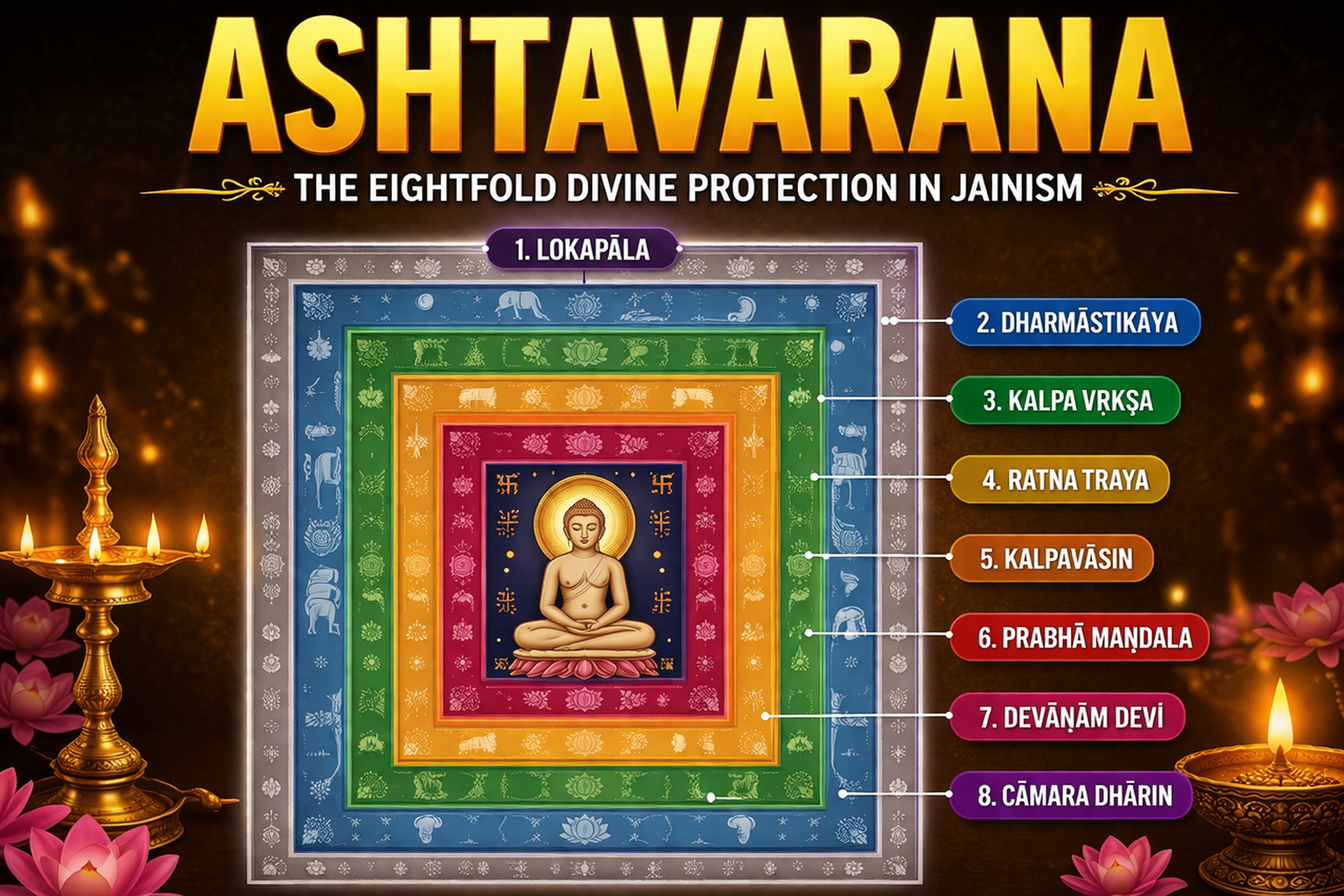
At the heart of Lingayat spiritual practice lies one of the most distinctive and systematic frameworks in Indian religious thought: the Ashtavarana, or the Eightfold Shield. In Lingayat theology, the Ashtavarana (ಅಷ್ಟಾವರಣ) refers to eight virtues that act as shields or coverings protecting the devotee from extraneous distractions and the influences of Maya — the world of illusion. The word itself is a compound of Ashta, meaning “eight,” and Avarana, meaning “covering” or “shield.” Together, these eight elements form not merely a checklist of religious obligations, but a complete architecture of spiritual life — governing how a Lingayat worships, what they wear, how they think, and what they receive from their practice.
The Ashtavarana protect the devotee from the onslaughts of Maya and guide them safely toward final liberation. They shield the practitioner from the evils of worldly life and guard and guide them on the way to enduring happiness by means of spiritual discipline and exercise. Understanding them requires first understanding the tradition from which they arose.
The World That Produced Ashtavarana: Lingayatism and Basavanna
The origins of Lingayatism are traced to the 11th and 12th centuries CE in a region that includes northern Karnataka and nearby districts of South India — a region that was then a stronghold of Jainism and Shaivism. Into this milieu was born one of medieval India’s most consequential spiritual and social reformers.
Basava was a 12th-century philosopher, statesman, and Kannada poet active in the Shiva-focused Bhakti movement, serving as a social reformer during the reign of the Kalachuri king Bijjala II in Karnataka. Born in 1134 AD in Bagewadi in northern Karnataka, Basavanna was a leading figure in the 12th-century Bhakti movement in South India. He established the Anubhava Mantapa, a forum for open discussions on spirituality and social reform, and his seminal contribution was the ideology of Lingayat Dharma, which advocated direct devotion to God without priests or elaborate rituals.
Basava championed devotional worship that rejected temple worship and rituals led by Brahmins, and replaced it with personalised, direct worship of Shiva through individually worn icons and symbols — most centrally, a small linga. This approach brought Shiva’s presence to everyone, at all times, without gender, class, or caste discrimination.
Basavanna was clearly way ahead of his time. He challenged Brahmanical superiority when rigid norms were strictly followed, empowered women to join his movement at a time when women had no rights, and promoted the dignity of labour before modern equality movements. His teachings circulated through a unique literary form called the Vachana — short, profound verses in Kannada designed to reach ordinary people, not just the learned elite.
Within this radical new theological system, the Ashtavarana occupied a central place. Veerashaivism’s means of attainment depend on three central concepts: Panchacharas (five codes of conduct), Ashtavarana (eight shields), and Shatsthala (six stages of the soul’s journey) — all central to Lingayat thought.
The Three Pillars of Lingayat Practice
Before examining each element of the Ashtavarana in detail, it helps to see how the concept fits within the broader framework of Lingayat life.
The Panchacharas describe the five codes of conduct to be followed by Lingayats, and include Lingachara (daily worship of the Ishtalinga), Sadachara (attention to vocation and duty), Sivachara (acknowledging Shiva as supreme and upholding equality), Bhrityachara (compassion towards all creatures), and Ganachara (defence of the community and its tenets).
Alongside maintaining right conduct, it is important to keep the mind pure. The Ashtavaranas are the eightfold shields that protect the devotee from worldly desires and attachments.
Finally, Shatsthala comprises six levels — Bhakta, Maheshwara, Prasadi, Pranalingi, Sharana, and Aikya — through which a soul advances in its ultimate quest for realisation of the Supreme. The Aikya Sthala culminates when the soul leaves the physical body and merges with the Supreme.
The Ashtavarana occupies the middle of this triad: it is the daily devotional shield that keeps the practitioner grounded and protected while they progress through the six stages.
The Eight Avaranas: A Detailed Examination
The eight shields are traditionally grouped into three clusters — the living presences to be revered, the sacred instruments of worship, and the fruits of practice.
1. Guru — The Living Guide
The Guru is the religious teacher. At a mature stage of spiritual development, one’s own conscious awareness — arivu — can itself become the Guru. This is a striking and radical idea. Rather than demanding eternal dependence on an external authority, Lingayat theology envisions a point at which the disciple’s own cultivated inner wisdom becomes the guiding force. The Guru is revered not as a god but as a human being who has traversed the path and can light the way for others.
Obedience towards the Guru is the first of the Ashtavaranas. This obedience is not blind submission but rather an act of trust and humility — an acknowledgement that the path to liberation is long and that wisdom transmitted from those who have walked it is invaluable.
2. Linga (Ishtalinga) — The Inner Self
The Linga is considered to be the self — the inner Atma. The Ishtalinga is a small, personal linga — typically made of light grey slate, coated with a paste of ash and oil — that every Lingayat wears on their body from birth. Lingayats consider the Ishtalinga as Lord Shiva himself, its worship called Ahangrahopasana, making it an amorphous representation of God.
The profundity of this element is that it collapses the distance between the worshipper and the worshipped. By wearing the divine on their body at all times, the Lingayat lives in continuous remembrance of the non-difference between their own self and Shiva. This is not idol worship in any conventional sense — it is a portable, personal, ever-present reminder of one’s own divine nature.
3. Jangama — The Walking Embodiment of Dharma
The Jangama is the human who wanders and propagates the teachings of dharma. Jangama refers to the worship of monks who have surrendered the pleasures and luxuries of life, revered as a reincarnation of Shiva.
The Jangama represents the living, moving expression of the teachings — compassion not in theory but in action. In a tradition that rejected the authority of a fixed priestly class tied to temples and hereditary privilege, the wandering Jangama embodies an alternative: holiness that moves freely through the world, available to all, tied to no hierarchy of birth.
A recurring contrast in Basava’s poems and ideas is of Sthavara and Jangama — “what is static, standing” versus “what is moving, seeking.” The Jangama is the living antithesis of calcified religious institution.
4. Vibhuti (Bhasma) — Sacred Ash
Vibhuti is the indication of purity. It symbolises the burning away of the desires of lust and greed for materialistic possessions and comfort. Vibhuti is holy ash created using cow dung.
Smearing ash on the body is one of the oldest Shaivite practices, and the Lingayats imbue it with clear philosophical meaning: the ash is what remains after everything impermanent is burnt away. To wear it is to declare that one has symbolically consigned worldly attachment to the fire, and that what remains — the essential self — is pure.
5. Rudraksha — The Third Eye of Shiva
Rudraksha beads are worn on the body. Available as Panchamukhi (five-faced) and Ekamukhi (single-faced) varieties, they are spiritually the symbol of the third eye of Mahadeva or Shiva — representing the inner conscious that plays the role of a third eye.
The third eye in Shaivite tradition is the eye of wisdom and discernment — the capacity to see through illusion to truth. Wearing the Rudraksha is thus a daily commitment to cultivating that discernment, to seeing the world clearly rather than through the distorting lens of desire and ego.
6. Mantra — Sacred Sound
Mantra consists of holy chanting words. Normally Lingayats chant “Om Lingaya Namah” and some chant “Om Namah Shivaya.” More precisely, the traditional Panchaakshari mantra is “Namah Shivaya” — five syllables — as distinct from the six-syllable “Om Namah Shivaya.”
The repetition of sacred sound is understood not as superstition but as a discipline of the mind. Mantra steadies and focuses attention, anchoring the practitioner in devotion when the mind drifts toward distraction. In the Lingayat understanding, it is one of the key instruments through which the Guru, Linga, and Jangama are properly honoured.
7. Padodaka — The Water of Knowledge
Padodaka is the sacred water obtained from bathing the Linga or the guru’s feet. At a deeper level, Padodaka can be spiritually interpreted as the knowledge that flows from Guru, Linga, and Jangama when they discuss daily concerns through the lens of Anubhava — lived experience.
The act of receiving Padodaka is one of profound humility — an acknowledgement that wisdom flows from those who embody truth, and that the sincere seeker must be willing to receive it. It democratises access to the sacred: the water is not confined to a temple or a caste; it flows wherever genuine devotion and wisdom meet.
8. Prasada — The Fruit of Practice
Prasada is the daily food accepted after worship. Spiritually, it represents the outcomes of sincere practice: acceptance, humility, and gratitude. To receive Prasada is to acknowledge that the fruits of one’s labour — material and spiritual — are ultimately a gift to be received with openness rather than seized through grasping.
Together, Padodaka and Prasada complete the circle of practice: one represents the wisdom received through engagement with the living community of devotion, and the other represents the nourishment — physical and spiritual — that sustains life when it is rightly oriented.
The Path from Saguna to Nirguna
The Ashtavarana is not merely a set of daily observances. It serves a profound philosophical function within the arc of Lingayat spiritual development. When a person follows the Ashtavarana for the body and Shatsthala for the mind, these gradually convert a person from Saguna (the divine with form and attributes) to Nirguna (the divine beyond all attributes), ultimately leading the self to rise and reach the Nirguna state through Nirguna Upasane.
This is a complete spiritual psychology. The eight shields are the outer scaffolding that supports and protects the practitioner while the inner transformation — from identification with form and desire toward the formless, attribute-free absolute — slowly unfolds through the six stages of Shatsthala.
A Theology of Equality
It is impossible to discuss the Ashtavarana without noting what was truly revolutionary about the theology it embodied. The entire system — personal linga worn by every devotee regardless of birth, a wandering teacher accessible to all, sacred ash and beads requiring no priestly intermediary — was designed to make liberation available to everyone.
The 12th-century Sharana movement flourished into the Lingayat faith, followed today by over 50 million people. The movement inspired later social reformers including Kabir, Guru Nanak, and Ambedkar-inspired social movements.
The Veerashaiva/Lingayat tradition, with its emphasis on devotion to Lord Shiva and rejection of caste discrimination, stands as a testament to Basavanna’s vision of social reform and spiritual equality. By promoting dignity of labour and rejecting traditional customs, it ushered in significant societal changes, paving the way for a more inclusive and egalitarian society.
Conclusion
The Ashtavarana is one of the most elegant and complete systems of daily spiritual practice in the Indian tradition. It is simultaneously a philosophy, a discipline, and a way of life — combining living human relationships (Guru, Jangama), a personal symbol of the divine (Linga), sacred material practices (Vibhuti, Rudraksha), a vocal discipline (Mantra), and the humble reception of wisdom and nourishment (Padodaka, Prasada). Each element supports the others; together they create a continuous, 360-degree protection against the forces of distraction, ego, and illusion.
Founded in the radical egalitarianism of Basavanna’s 12th-century vision, the Ashtavarana remains a living practice for millions of Lingayat devotees today — a daily reminder that the path to the divine runs not through temples and priests, but through the disciplined, humble, and compassionate life of every sincere practitioner.
Also read more about: SimpCity in 2026:The Complete Guide
Beginner Philosophical Questions for Couples (Deep & Fun Conversations)
What Colors Mixed Together Will Make Blue? (Complete Guide with Charts, Science & Real Data)







One thought on “Ashtavarana: The Eightfold Shield of Lingayat Theology 2026”