Bernhard Weißbach: Biography, History, Military Career, and the Story Behind the Name
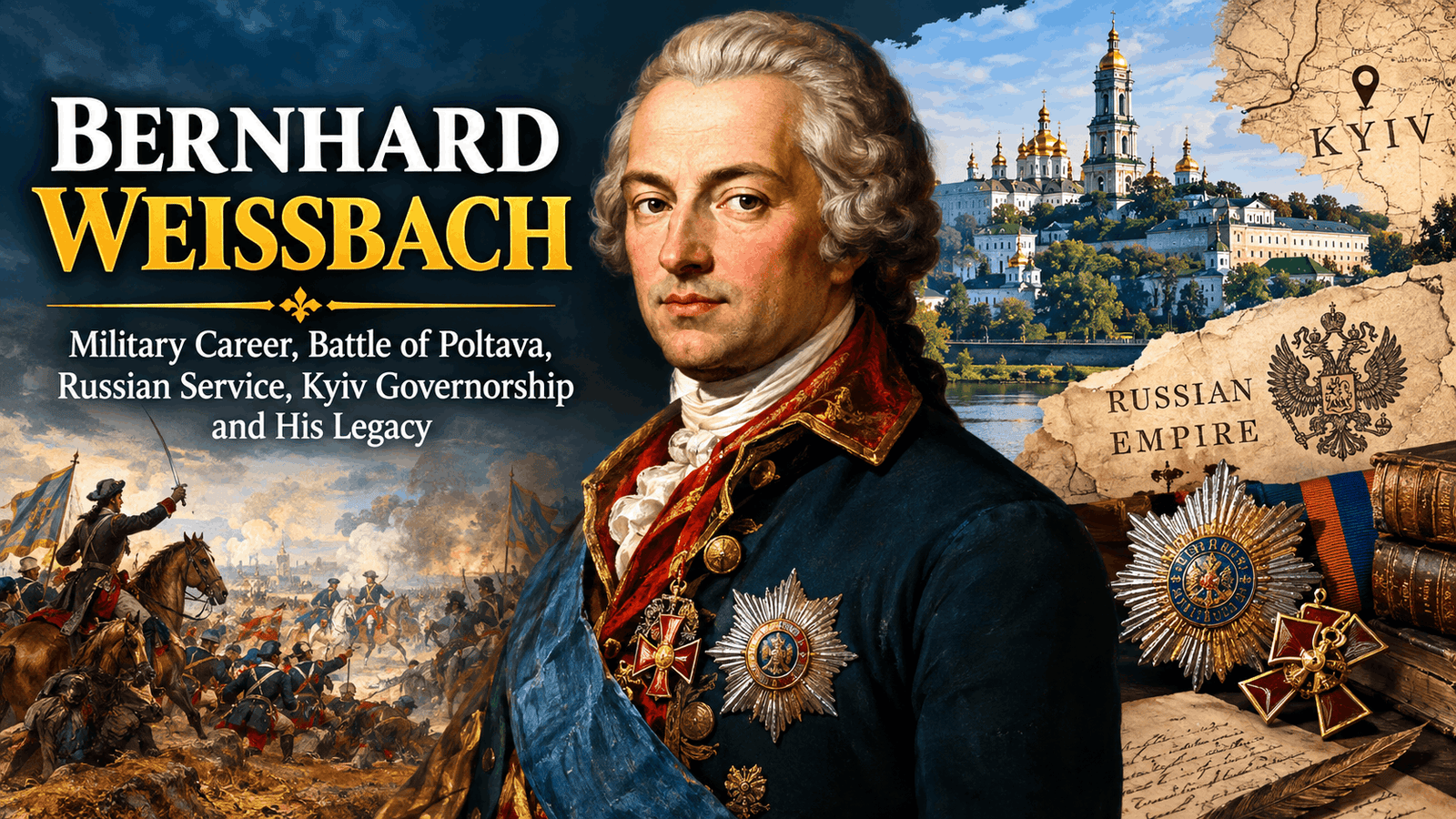
Bernhard Weißbach is a name that can lead researchers into several different historical records. On the modern internet, the name is frequently connected with Johann Bernhard von Weisbach, an important military officer, diplomat, and administrator who served the Russian Empire during the age of Peter the Great.
However, the name requires careful examination. Historical records also contain unrelated people named Bernhard Weißbach, meaning that information about different individuals can easily become mixed together.
The most historically significant figure associated with the name is Johann Bernhard von Weisbach, a Central European military professional who rose to senior rank in Russian service. His career connected the military conflicts of the Great Northern War with Russian diplomacy, frontier administration, and the government of Kyiv.
His story is therefore much more than a simple biography. It provides a window into the political and military transformation of Europe during the late seventeenth and early eighteenth centuries.
Who Was Bernhard Weißbach?
In historical discussions, Bernhard Weißbach is commonly associated with Johann Bernhard von Weisbach, also appearing in historical sources under forms such as Weisbach, Weissbach, Weißbach, Graf Weißbach, and Veisbakh.
Johann Bernhard von Weisbach was a military officer who eventually became a senior commander in Russian service. He was active during the period when Peter the Great was transforming Russia into a stronger European military and political power.
His career included:
- Military service in Central Europe
- Entry into Russian service
- Cavalry command
- Participation in the Great Northern War
- Involvement in the Battle of Poltava
- Diplomatic service
- Senior military administration
- Service in Kyiv
- Frontier-defense responsibilities
- The governorship of Kyiv
He died in 1735, bringing to an end a career that had stretched across military, diplomatic, and administrative institutions.
Importantly, he should not automatically be confused with every modern or historical person called Bernhard Weißbach.
Bernhard Weißbach at a Glance
| Category | Historical Information |
|---|---|
| Historical identity | Johann Bernhard von Weisbach |
| Name variations | Weisbach, Weissbach, Weißbach, Graf Weißbach, Veisbakh |
| Birth | 1665 |
| Death | 1735 |
| Historical period | Late 17th and early 18th century |
| Profession | Military officer, cavalry general, diplomat, administrator |
| Major state service | Russian Empire |
| Major conflict | Great Northern War |
| Famous battle | Battle of Poltava, 1709 |
| Diplomatic connection | Vienna |
| Major administrative position | Governor-General of Kyiv |
| Kyiv service | 1731–1735 |
| Historical association | Peter the Great and Russian imperial expansion |
Some details concerning his early life and precise birthplace are less certain than the information about his later military career.
Early Life and Background
Johann Bernhard von Weisbach was born in 1665.
His early biography is not documented as extensively as his later military and political career. Historical descriptions generally place him within the Central European world of the Holy Roman Empire, with sources differing over the precise regional description of his origin.
This uncertainty is not unusual for seventeenth-century military figures.
Unlike modern public figures, officers of this period often left behind records primarily when they entered military service, received a promotion, participated in a campaign, obtained a title, or took a government position.
Consequently, there is considerably more information about Weisbach’s professional career than about his childhood, education, private relationships, or personal interests.
What is clear is that he emerged from the Central European military environment and developed enough experience to become part of the international military elite of his period.
Military Europe in the Age of Weisbach
To understand Bernhard Weißbach, it is necessary to understand the Europe in which he lived.
The late seventeenth and early eighteenth centuries were dominated by competition among powerful states. Sweden, Russia, the Habsburg monarchy, the Polish-Lithuanian Commonwealth, the Ottoman Empire, and other European powers competed for territory, influence, trade routes, and strategic advantage.
Military professionals could therefore become international figures.
An experienced officer might begin service under one ruler and later enter another state’s army. This was particularly important for Russia under Peter the Great.
Peter wanted to modernize Russia’s armed forces and strengthen the state. Foreign military expertise was valuable because European officers could bring experience in cavalry operations, artillery, fortifications, organization, logistics, and military administration.
Weisbach’s career fits into this broader transformation.
Entry Into Russian Service
One of the major turning points in Weisbach’s career was his transition into Russian service.
His experience made him useful to a Russian state that was attempting to compete with established European military powers.
Russia was involved in the Great Northern War, a conflict that fundamentally changed the balance of power in Northern and Eastern Europe.
The war placed Russia against Sweden and its allies, and the conflict became one of the defining struggles of Peter the Great’s reign.
For officers such as Weisbach, the war offered opportunities for advancement but also exposed them to extremely demanding military conditions.
The Great Northern War
The Great Northern War began in 1700 and continued until 1721.
At the beginning of the conflict, Sweden was one of Europe’s strongest military powers. King Charles XII had built a reputation for aggressive campaigning and battlefield success.
Russia initially suffered serious setbacks.
Peter the Great responded by continuing military reforms, reorganizing his forces, improving training, and developing new military institutions.
Over time, Russia became increasingly effective.
Weisbach’s career developed during this transformation.
His military service placed him within the Russian military system at a moment when Russia was moving from early defeats toward major victories.
Bernhard Weißbach and the Battle of Poltava
The most famous military event associated with Johann Bernhard von Weisbach is the Battle of Poltava, fought in 1709.
Poltava was one of the decisive battles of the Great Northern War.
Russian forces under Peter the Great confronted the Swedish army commanded by Charles XII.
The battle ended in a major Russian victory and represented a turning point in the war.
Weisbach was associated with the Russian cavalry during the battle, particularly with cavalry operations on the Russian side.
His participation is important because Poltava was not simply another battle. Its consequences were enormous.
The Swedish military power that had dominated Northern Europe was severely weakened, while Russia emerged as an increasingly important European power.
For Weisbach, participation in such a major victory contributed to his later advancement.
Why the Battle of Poltava Was So Important
Poltava deserves special attention because it changed the strategic balance of Europe.
Before the battle, Sweden had been a dominant military force in Northern Europe.
After Poltava, Russia increasingly became the major power in the region.
The battle also strengthened Peter the Great’s broader program of military and governmental reform.
Weisbach’s career therefore needs to be understood within this larger transformation.
He was not the central political figure at Poltava—that role belongs to Peter the Great and the major commanders of the Russian and Swedish armies—but his association with the Russian cavalry demonstrates his position within the professional military structure that helped produce the Russian victory.
Military Advancement After Poltava
The years following Poltava were important for Weisbach.
Russian military success created opportunities for experienced commanders, and Weisbach continued to serve in increasingly important positions.
His career extended beyond a single battlefield.
He became involved in campaigns connected with Russia’s wider conflicts and frontier concerns, including military operations in areas affected by the Ottoman Empire and Crimean Tatars.
This demonstrates one of the defining features of his career: he was not simply a battlefield officer.
He gradually became a senior figure capable of combining military command with political and administrative responsibilities.
Diplomatic Career and Vienna
Another fascinating part of Weisbach’s biography is his involvement in diplomacy.
In the early eighteenth century, military and diplomatic careers were often closely connected.
Senior officers could serve on diplomatic missions because they understood military affairs, court politics, alliances, and their governments’ strategic interests.
Weisbach became associated with a Russian diplomatic mission to Vienna.
Vienna was one of Europe’s most important political centers because it was the seat of the Habsburg monarchy.
Russia’s relationship with the Habsburg world was strategically important, particularly as Russia expanded its influence in Europe.
Weisbach’s diplomatic role therefore demonstrates that Russian authorities valued him for more than battlefield skills.
He had become a representative of imperial interests.
From General to Administrator
Weisbach’s career later moved increasingly toward high-level administration.
This was a natural development for an experienced military commander.
Early modern empires frequently depended on senior military officers to administer strategically important territories.
Such positions required knowledge of:
- Military logistics
- Fortification
- Regional security
- Troop deployment
- Political relationships
- Government administration
- Frontier defense
Weisbach’s military background made him particularly suited to this type of role.
His later career in the Kyiv region is an important example.
Bernhard Weißbach and Kyiv
One of the most significant positions associated with Johann Bernhard von Weisbach was Governor-General of Kyiv.
He took this position in 1731 and remained in the role until his death in 1735.
Kyiv was strategically important.
It occupied a sensitive position within the Russian Empire’s southwestern sphere and was connected with military, administrative, religious, and economic interests.
The region was also closely connected to Russia’s frontier concerns involving the Ottoman Empire and Crimean Tatars.
Consequently, governing Kyiv required much more than ordinary civil administration.
Military considerations were central to the position.
The Ukrainian Frontier
During Weisbach’s later career, Russia was heavily concerned with the defense of its southern and southwestern frontier.
One important element of this defensive strategy was the development of fortified lines and military settlements.
The Ukrainian Line was part of a wider effort to defend Russian-controlled territory against raids and military incursions.
Weisbach’s military experience made him relevant to these projects.
Historical research concerning the Karlivka region, for example, highlights the role of Johann Bernhard Weisbach in the early development of defensive infrastructure in the area.
This illustrates an important transition in his career.
Earlier in life, Weisbach had commanded cavalry in major wars.
Later, he was involved in the broader strategic problem of defending and administering territory.
The Karlivka Connection
Weisbach’s name is also connected with the early history of Karlivka in present-day Ukraine.
Historical research has examined his role in the development of the region during the early 1730s.
This is significant because it provides a more local view of his administrative influence.
Rather than viewing Weisbach only as a general who fought in famous European wars, the Karlivka material shows how imperial military policy affected individual settlements and frontier regions.
The development of fortifications, administrative centers, military routes, and defensive infrastructure was part of the broader Russian strategy for securing its southern territories.
Weisbach was involved in this environment during the final years of his career.
Titles, Honors, and Status
Weisbach’s advancement was accompanied by honors and high rank.
His career eventually brought him to the level of General of Cavalry and later one of the highest grades of military command.
He also received important imperial distinctions.
Historical accounts associate him with the Order of St. Alexander Nevsky and the Order of St. Andrew, two prestigious honors of the Russian Empire.
He was also associated with the title of count under Emperor Charles VI.
These honors are significant because they show the international character of his career.
Weisbach had connections to both the Central European and Russian political worlds.
His career demonstrates how military professionals could cross political borders and accumulate status through service to different imperial systems.
The Final Years of Bernhard Weißbach
The final stage of Weisbach’s life remained connected to military affairs.
In 1735, preparations were being made for another Russian campaign involving the Crimean Tatars.
The Crimean frontier was a major strategic concern for Russia.
Unfortunately, Weisbach did not live to complete the campaign.
He died in 1735, in Poltava, the same region associated with the great Russian victory of 1709.
His death brought an end to a career that had included military command, diplomacy, and imperial administration.
Historical accounts associate his burial with Poltava, although details concerning the exact burial location are less certain.
Bernhard Weißbach: Career Timeline
1665
Johann Bernhard von Weisbach is generally recorded as being born.
Early career
He developed his military career within the Central European military environment.
1707
He entered Russian service during Peter the Great’s period of military expansion.
1708
He participated in campaigns connected with the Great Northern War.
1709
He participated in the Battle of Poltava, one of the decisive victories of the Russian army over Sweden.
1711
He was involved in the Russian campaign associated with the Pruth conflict.
1710s
His career expanded beyond battlefield command and included important military and diplomatic responsibilities.
1719
He became associated with a Russian diplomatic mission to Vienna.
1720s
He continued serving in senior military and administrative roles.
1725
He reached the rank of General of Cavalry.
1730
He received the Order of St. Alexander Nevsky.
1731
He became Governor-General of Kyiv.
1733
He received another major Russian imperial honor, the Order of St. Andrew.
1735
He died in Poltava while connected with preparations for another military campaign.
Was Bernhard Weißbach the Same Person as Johann Bernhard von Weisbach?
This is one of the most important questions surrounding the name.
In historical material concerning the eighteenth-century military figure, Weißbach, Weissbach, Weisbach, and Veisbakh can appear as different forms of the same historical name.
Language and transliteration explain much of this variation.
German uses ß, while English-language sources often replace it with ss. Russian historical sources and translations can produce additional spellings through transliteration.
Therefore, someone searching for “Bernhard Weißbach” may encounter references to “Johann Bernhard von Weisbach” or “Veisbakh.”
However, this does not mean every person named Bernhard Weißbach is the eighteenth-century general.
That distinction is essential.
Other People Named Bernhard Weißbach
Historical and modern databases contain other individuals with the name Bernhard Weißbach.
For example, the Dresden Documentation Centre’s database records a Bernhard Weißbach who was born on 12 May 1924 in Schreibersdorf, and whose historical record concerns a conviction in 1950 and a later rehabilitation decision.
This individual clearly belongs to the twentieth century and should not be merged with Johann Bernhard von Weisbach, who died in 1735.
There are also modern German business records containing a Dr. Bernhard Weißbach.
These examples demonstrate why a simple internet search for the name can produce confusing results.
A person’s name is not sufficient evidence for identifying them.
Why Online Articles About Bernhard Weißbach Can Be Misleading
Recent online articles frequently present Bernhard Weißbach as though there were one universally recognized person with that exact name.
Some correctly identify the historical figure as Johann Bernhard von Weisbach.
Others discuss modern namesakes.
Some articles go further and combine details from different historical records without providing sufficient evidence that the individuals are the same.
This is a common problem with biographies created from search-engine results.
A responsible biography should distinguish:
Confirmed identity → historical evidence → interpretation → unresolved questions.
It should not turn similar names into a single biography simply because doing so produces a more complete article.
Bernhard Weißbach and the Problem of Historical Names
The Weißbach/Weisbach case demonstrates a broader problem in historical research.
Names change when they move between languages.
For example:
Weißbach → Weissbach → Weisbach → Veisbakh
can represent spelling or transliteration differences rather than entirely different people.
At the same time, two completely unrelated people can have exactly the same name.
This means researchers need to compare:
- Dates
- Locations
- Occupations
- Military units
- Titles
- Family connections
- Government positions
- Historical events
Only when these details align can two records reasonably be treated as belonging to the same person.
What Made Johann Bernhard von Weisbach Historically Important?
Weisbach is not remembered as one of the most famous individuals of the Great Northern War.
He was not Peter the Great, Charles XII, or one of the era’s most celebrated commanders.
His importance is different.
His career shows how the Russian Empire developed through the work of experienced military professionals.
He represents a generation of officers who helped Russia:
- Modernize its armed forces
- Compete successfully against Sweden
- Expand its influence in Eastern Europe
- Strengthen frontier defenses
- Develop military administration
- Connect military service with diplomacy
- Govern strategically important territories
His life therefore provides a useful case study of how an empire built its institutions.
Bernhard Weißbach’s Connection to Peter the Great
Weisbach’s career overlapped significantly with the reign of Peter the Great.
Peter’s objective was to transform Russia into a powerful European state.
Military reform was one of his most important projects.
Russia needed experienced officers, better organization, improved training, stronger fortifications, and new approaches to warfare.
Weisbach became part of this system.
His rise demonstrates how Peter’s military reforms created opportunities for skilled officers from outside Russia.
The relationship should therefore be understood institutionally rather than as a personal friendship unless specific evidence establishes otherwise.
His Role in the Transformation of Russia
Weisbach’s career illustrates a larger historical transformation.
Russia entered the eighteenth century as a major regional power with ambitions for greater influence.
By the time Weisbach died in 1735, Russia had become a much more influential European power.
The Battle of Poltava was central to this transformation.
The administrative work carried out in Ukraine and other frontier regions was another part of the process.
Military victories alone could not maintain an empire.
Russia also needed:
- Roads
- Fortifications
- Garrisons
- Administrative centers
- Supply systems
- Diplomatic relationships
- Experienced commanders
Weisbach’s career touched many of these areas.
Personal Life and Family
One of the weakest areas of available information about Bernhard Weißbach is his private life.
There is much stronger evidence concerning his military and political career than concerning:
- Childhood experiences
- Education
- Marriage
- Spouse
- Children
- Personal hobbies
- Private correspondence
- Physical appearance
- Personal wealth
It is therefore better not to invent or repeat unsupported claims about these subjects.
For historical figures, absence of information does not mean that these aspects did not exist.
It means that the surviving evidence available to modern researchers does not establish them clearly enough.
Was Bernhard Weißbach Famous?
Not in the modern celebrity sense.
Johann Bernhard von Weisbach was a historical military and political figure.
His significance comes from his professional service rather than popular culture.
He is particularly relevant to readers interested in:
- Peter the Great
- Russian military history
- The Great Northern War
- The Battle of Poltava
- Kyiv history
- Ukrainian frontier history
- European diplomacy
- Early modern military professionals
- Russian imperial expansion
His name is therefore more important to historians than to celebrity culture.
Frequently Asked Questions
Who was Bernhard Weißbach?
The name Bernhard Weißbach is associated with several individuals. In historical discussions, it is often used in connection with Johann Bernhard von Weisbach, an eighteenth-century military officer, diplomat, and administrator who served the Russian Empire.
When was Bernhard Weißbach born?
Johann Bernhard von Weisbach is generally recorded as having been born in 1665.
When did Bernhard Weißbach die?
Johann Bernhard von Weisbach died in 1735, in Poltava.
Was Bernhard Weißbach a Russian general?
The historical figure Johann Bernhard von Weisbach became a senior military commander in Russian service and reached the rank of General of Cavalry.
Was Bernhard Weißbach at the Battle of Poltava?
Yes. Johann Bernhard von Weisbach is associated with Russian cavalry operations during the Battle of Poltava in 1709.
What was the Battle of Poltava?
The Battle of Poltava was a major 1709 battle during the Great Northern War. Russian forces defeated the Swedish army, greatly strengthening Russia’s position in Northern and Eastern Europe.
Was Bernhard Weißbach Governor-General of Kyiv?
Yes. Johann Bernhard von Weisbach served as Governor-General of Kyiv from 1731 until 1735.
Was Bernhard Weißbach a diplomat?
Yes. His career included diplomatic responsibilities, including a mission associated with Vienna.
Why is his name spelled Weisbach instead of Weißbach?
Historical names were recorded differently across languages. German, English, and Russian sources can produce forms such as Weißbach, Weissbach, Weisbach, and Veisbakh.
Was every Bernhard Weißbach the same person?
No. This is one of the most important points when researching the name.
There are documented people named Bernhard Weißbach from different periods. For example, a Dresden historical database records a Bernhard Weißbach born in 1924. That individual should not be confused with Johann Bernhard von Weisbach, who died in 1735.
What is Bernhard Weißbach best known for?
The historical figure most strongly associated with the name is known for military service under the Russian Empire, participation in the Great Northern War and Battle of Poltava, diplomatic activity, and his later position as Governor-General of Kyiv.
Final Assessment
The story of Bernhard Weißbach is more complicated than many modern online biographies suggest.
The name does not identify one universally documented individual. Instead, it appears across different historical and modern records.
The most historically significant figure connected with the name is Johann Bernhard von Weisbach, a Central European-born military professional who became a senior Russian commander, diplomat, and administrator.
His career unfolded during one of the most important periods of Russian expansion.
He served during the Great Northern War, became associated with the Russian victory at Poltava, participated in diplomatic affairs, advanced to senior military rank, and eventually became Governor-General of Kyiv.
His final years were closely connected with the military and administrative affairs of the southwestern Russian frontier.
At the same time, the existence of other people named Bernhard Weißbach means that modern researchers should resist the temptation to combine every search result into one biography.
The most accurate way to understand the subject is therefore to distinguish Johann Bernhard von Weisbach, the eighteenth-century military and political figure, from unrelated individuals who happened to share the name.
That distinction makes the biography less sensational—but considerably more reliable.
Sources and Research Notes
The research for this article was compared across recent online biographies, historical databases, and regional historical material. Particularly useful evidence included the Dresden Documentation Centre’s person database for distinguishing the twentieth-century Bernhard Weißbach from the eighteenth-century Weisbach, as well as historical research concerning Weisbach’s role in the Karlivka region.
Recent online biographies consistently associate Johann Bernhard von Weisbach with the Great Northern War, Poltava, Vienna diplomacy, and the Kyiv governorship, although some details—especially his exact origin and some aspects of his early life—vary between sources.
The central conclusion is therefore intentionally cautious: Bernhard Weißbach should not be treated as an automatically unique identity, while Johann Bernhard von Weisbach can be treated as the principal historical figure associated with the name in this context.
READ MORE ABOUT Donna Sicuranza: Two Lives Behind One Name