Braves Marcell Ozuna Waiver Candidate: The Complete 2026 Story, Career Stats & What Really Happened
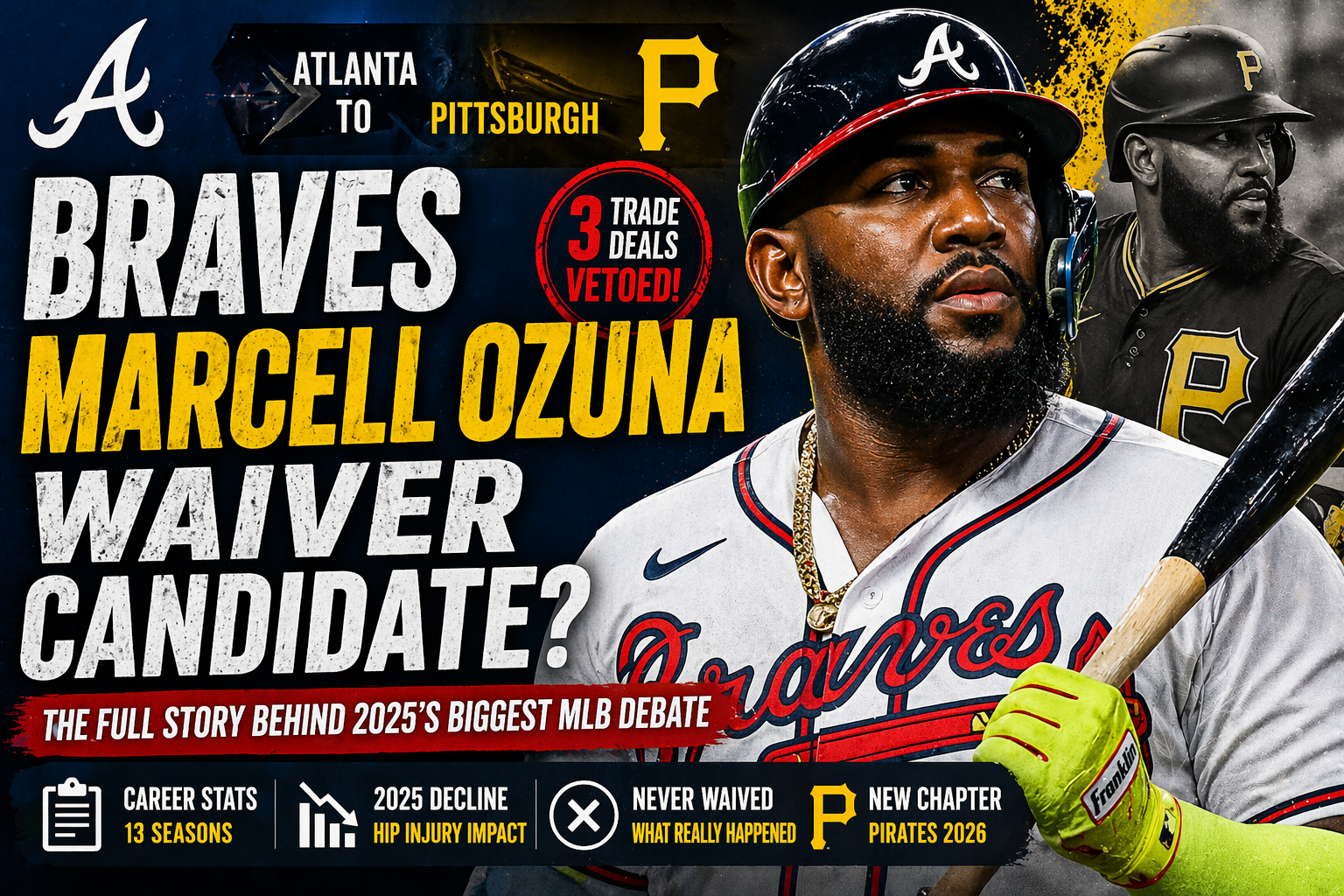
The phrase “Braves Marcell Ozuna waiver candidate” became one of the most searched and debated topics in MLB circles throughout the 2025 season. Fan forums, sports media, and baseball analysts all wrestled with the same question: would the Atlanta Braves place their veteran designated hitter on waivers, cut ties entirely, or find a trade partner before the season ended?
The reality turned out to be more nuanced than the headlines suggested — and the full story involves a historic six-season run in Atlanta, a significant performance decline driven by injury, three vetoed trade deals, a clean free-agent exit, and a rocky 2026 start with the Pittsburgh Pirates.
This comprehensive guide covers everything: Ozuna’s complete career timeline, season-by-season statistics, the anatomy of the 2025 waiver speculation, how MLB waivers actually work, and where things stand today in the spring of 2026.
Who Is Marcell Ozuna? The Full Profile
Marcell Ozuna Idelfonso — nicknamed “The Big Bear” — was born on November 12, 1990, in Santo Domingo, Dominican Republic. He stands 6-foot-1 and weighs 251 pounds, bats and throws right-handed, and has spent the majority of his professional career as a designated hitter and outfielder in Major League Baseball.
Ozuna was signed by the Miami Marlins as an amateur free agent out of the Dominican Republic in 2008. He made his MLB debut with the Marlins in 2013, beginning what would become a 13-year major league career spanning four franchises.
Career Honors and Awards
- 3× MLB All-Star: 2016, 2017, 2024
- 2× Silver Slugger Award: 2017 (OF), 2020 (DH)
- Rawlings Gold Glove Award: 2017 (OF)
- NL Home Run Leader: 2020 (60-game shortened season)
- NL RBI Leader: 2020
- NL Total Bases Leader: 2020
- 4th in NL MVP Voting: 2024
- All-MLB First Team (DH): 2020
- Edgar Martinez Outstanding DH Award: 2020
These accomplishments establish Ozuna as one of the more decorated offensive players of his generation — a fact often lost in the waiver speculation narrative that dominated 2025 coverage.
Career Timeline: From Santo Domingo to the Steel City
Miami Marlins (2013–2017): Establishing the Foundation
Ozuna’s development with Miami followed a classic trajectory — steady improvement building toward a breakout season. His 2017 campaign was transformative:
- .312 batting average (4th in NL)
- 37 home runs (3rd in NL)
- 124 RBI (3rd in NL)
- Gold Glove Award in left field
- Silver Slugger Award
- First All-Star selection
That performance made him one of the most coveted players entering the 2017–18 offseason. The Marlins, beginning a teardown rebuild, traded him to St. Louis.
St. Louis Cardinals (2018–2019): Solid Production, First Postseason
With the Cardinals, Ozuna produced respectable but unspectacular numbers as he transitioned toward a more traditional slugger profile. His most memorable Cardinals moment came in the 2019 NLDS against the Atlanta Braves, where he slashed .429 with 9 hits and 5 RBI in five games — a performance that ironically preceded his signing with the team he just dominated.
Atlanta Braves (2020–2025): The Peak and the Decline
Ozuna’s tenure in Atlanta represents both the peak of his career and the beginning of a gradual decline that would ultimately define his final years with the organization. The six-season arc is worth examining in detail.
Marcell Ozuna’s Complete Year-by-Year Stats With the Braves
2020: The Career Year (60-Game Season)
| Stat | Value |
|---|---|
| Batting Average | .338 |
| On-Base Percentage | .431 |
| Slugging Percentage | .636 |
| OPS | 1.067 |
| Home Runs | 18 (1st in NL) |
| RBI | 56 (1st in NL) |
| Total Bases | 145 (1st in NL) |
| wRC+ | 178 |
| Games | 60 |
Ozuna’s 2020 campaign — compressed by the COVID-shortened season — was statistically elite by any measure. His .338 average ranked third in the NL, his OBP ranked third, and his slugging ranked third. He won the Silver Slugger, the Edgar Martinez DH Award, and finished sixth in NL MVP voting. For a one-year, $18 million contract, it ranked as one of the best free-agent investments the Braves ever made.
2021: The Down Year and Off-Field Incident
Ozuna’s 2021 season was significantly disrupted. He appeared in only 48 games, posting a .213/.291/.354 slash line with 7 home runs and 26 RBI — a dramatic fall from his 2020 heights.
On May 29, 2021, Ozuna was arrested and charged with aggravated assault by strangulation and battery after Sandy Springs Police observed the incident. He was suspended by MLB for 20 games under the joint domestic violence policy following the incident. His .164 average against four-seam fastballs during the limited games he played suggested the disruption had measurable on-field consequences as well.
2022: Partial Recovery
| Stat | Value |
|---|---|
| Batting Average | .226 |
| Home Runs | 23 |
| RBI | 56 |
| OPS | .687 |
| Strikeouts | 122 |
| Games | 124 |
The 2022 season showed recovery in power production but raised concerns about strikeout rate and contact quality. Ozuna participated in five back-to-back home run sequences with teammates — leading the NL in that category — but the overall numbers represented a significant regression from his 2020 peak.
2023: Back to Elite (Career-Best HR Total)
| Stat | Value |
|---|---|
| Batting Average | .274 |
| Home Runs | 40 (career high) |
| RBI | 100 |
| OPS | .853 |
| Games | 149 |
Ozuna’s 2023 rebound was emphatic. He hit his 39th and 40th home runs on the final day of the regular season, helping the Braves tie the 2019 Minnesota Twins’ single-season franchise record for home runs as a team. His 17-game hitting streak in 2023 was the longest of his career.
2024: The Best Full Season of His Career
| Stat | Value |
|---|---|
| Batting Average | .302 |
| On-Base Percentage | .378 |
| Slugging Percentage | .546 |
| OPS | .925 |
| Home Runs | 39 |
| RBI | 104 |
| Doubles | 31 |
| Runs Scored | 96 |
| Games | 162 (career high) |
| xwOBA | .393 |
Ozuna’s 2024 season was, by most measures, the finest full season of his career. He played all 162 games — a career first — and finished fourth in NL MVP voting. His .302/.378/.546 slash line ranked among the elite DH performances in baseball. He set career highs in games played, OBP, doubles, runs scored, plate appearances (688), and multi-hit games (51).
For a team that struggled through injuries across its roster, Ozuna was the offensive anchor. He ranked eighth among NL qualifiers in both OBP and slugging percentage and matched his career high in extra-base hits (70). Entering 2025, expectations were high.
2025: The Hip Injury and the Decline
| Month | Batting Average | OPS | Notes |
|---|---|---|---|
| April | .283 | .915 | Strong start, no injury concern |
| May | .277 | .851 | Managing early hip discomfort |
| June | .188 | .550 | Hip tear worsening, production collapses |
| July | .167 | ~.600 | OBP rose to .354 as walk rate increased |
| August (2-week hot streak) | .255 | .949 | 5 HRs, looked like former self |
| August (final 8 games) | .087 | .345 | Slump returns |
| September | .261 | ~.800 | 6 HRs, partial recovery |
Full 2025 Season Totals:
| Stat | Value |
|---|---|
| Batting Average | .232 |
| Home Runs | 21 |
| RBI | 68 |
| Games | 145 |
The contrast with 2024 is stark. Ozuna’s home run total dropped from 39 to 21, his RBI fell from 104 to 68, and his batting average dropped 70 points. The root cause was a right hip tear that Ozuna attempted to play through rather than address with surgery. The injury affected his bat speed, his ability to drive inside pitches, and his overall movement at the plate.
Reports later confirmed that Ozuna had vetoed three separate trade deals arranged by the Braves before the July 31 deadline. His no-trade clause — included in his prior contract structure — gave him the right to block those transactions. This detail is critical to understanding the waiver narrative: the Braves did not fail to move Ozuna because of lack of interest. They were blocked by Ozuna himself.
The Waiver Candidate Narrative: What Really Happened
Why the Speculation Gained Momentum
The “Braves Marcell Ozuna waiver candidate” storyline grew from a confluence of legitimate factors:
The Braves’ standings collapse. Atlanta entered 2025 as a playoff contender but fell out of the wild-card race earlier than expected — at one point trailing by 12 games in the wild-card standings. Teams in this position typically evaluate roster moves, including placing veterans on waivers to free salary and create space for younger players.
Ozuna’s contract situation. His deal — originally structured as part of his post-2020 re-signing — was entering its final year in 2025 at approximately $16 million. That salary becomes harder to justify when production falls from .302/39 HRs to .232/21 HRs, especially when the team is no longer in playoff contention.
Bleacher Report’s Kerry Miller analysis. By August 2025 — the month that matters for waiver discussions — Miller had specifically named Ozuna and Raisel Iglesias as prime waiver wire candidates based on the Braves’ standings position and the players’ contracts. This piece circulated widely and seeded the narrative.
Limited trade market. The Braves reportedly explored trades before the July 31 deadline and found limited interest from buyers — partly because Ozuna’s injury concerns reduced his perceived value, and partly because the DH-only limitation narrowed the pool of interested teams.
What Actually Happened
Despite months of speculation, the Braves never placed Marcell Ozuna on waivers. The waiver discussion was exactly that — discussion. Ozuna remained on the active roster through the end of the 2025 season. His contract expired naturally at season’s end.
He entered free agency as a 35-year-old with a complicated injury history, a significant one-year production dip, a DH-only profile, and three vetoed trade deals on his record. Braves GM Alex Anthopoulos addressed reporters about Ozuna’s future after the season: “We haven’t closed the door on guys like [Marcell Ozuna], but we just don’t know. If someone who is a pure DH is the right move, we’ll make it. But right now, we’re not committed to anything.”
The Braves ultimately did not pursue re-signing him. Ozuna’s six-year tenure in Atlanta ended through free agency, not through waivers, release, or trade.
How MLB Waivers Actually Work: A Complete Explainer
The confusion surrounding the “Ozuna waiver candidate” discussion reflects genuine misunderstanding of how MLB’s waiver system operates. Here is the complete process:
The Two Types of Waivers
Outright waivers (post-August 31): After the August 31 roster deadline, teams can no longer make trades without first placing the player on waivers. Any team in the league — prioritized by reverse standings — can claim the player and take over his contract. If no team claims him within 48 hours, the original team can release him, trade him, or send him to the minors.
Designated for assignment (DFA): A player designated for assignment has 10 days to be traded, released, or pass through waivers to the minor leagues. Any team can claim him off waivers and take the remaining contract.
The Claim Hierarchy
When a player is placed on waivers:
- Teams in the same league claim priority over the other league
- Within the same league, the team with the worst record gets first claim
- If claimed, the claiming team assumes the full remaining salary obligation
Why Veterans Are Placed on Waivers
Teams use waivers strategically for multiple reasons:
- Payroll reduction: Moving a high-salary veteran frees up luxury tax space
- Roster flexibility: Opens a 26-man roster spot for a younger player or prospect
- Asset recovery: Even a waiver claim can return draft pick compensation in some structures
- Testing the market: Placing a player on waivers reveals whether other teams have interest, informing potential release decisions
A waiver claim does not imply poor performance — it reflects team strategy, competitive position, and financial planning.
Why Ozuna Was Never Actually on Waivers
The Braves’ decision not to use the waiver process came down to two factors: Ozuna’s no-trade clause gave him leverage to block moves, and the organization ultimately decided that finishing the season with him on the roster and entering free agency cleanly was preferable to the contractual and PR complexity of a waiver transaction.
Marcell Ozuna Signs With the Pittsburgh Pirates: February 2026
On February 16, 2026, Ozuna signed a one-year contract with the Pittsburgh Pirates — a signing that carried significant strategic intent for both parties.
Contract Details
| Term | Value |
|---|---|
| Contract length | 1 year |
| 2026 salary | $12 million |
| 2027 mutual option | $16 million |
| Option buyout | $1.5 million |
Why the Pirates Signed Him
The Pirates, a young and ascending NL Central team, saw Ozuna as a calculated risk: a proven middle-of-the-order bat who, if healthy, could anchor a lineup that lacked a proven power threat in the DH slot. His underlying metrics from 2023–2024 — particularly his elite exit velocity and barrel rate — suggested the 2025 decline was injury-related rather than indicative of permanent decline.
The risk factors were equally clear: a 35-year-old DH with no defensive utility, an unresolved hip injury history, and a 2025 season significantly below his recent production. The Pirates’ inability to slot him anywhere but the DH spot also left their already-thin defense even more exposed.
2026 Season With Pittsburgh: Early Struggles and the Analytics Defense
Early Season Statistics
Through the first 10 games of the 2026 season with Pittsburgh, Ozuna’s numbers were alarming by any conventional measure:
| Stat | Value |
|---|---|
| Batting Average | .051 |
| On-Base Percentage | .159 |
| Slugging Percentage | .051 |
| OPS | .210 |
| Home Runs | 0 |
| RBI | 0 |
| Strikeouts | 8 in 31 plate appearances |
What the Advanced Metrics Say
The surface-level statistics are discouraging, but Baseball Savant’s Statcast data and underlying analytics present a more complicated picture:
| Advanced Stat | 2026 Value |
|---|---|
| Average Exit Velocity | 88.1 mph |
| Hard Hit % | 41.2% |
| wOBA | .256 |
| xwOBA | .320 |
| Barrel % | 9.8% |
The xwOBA of .320 — the expected weighted on-base average based on quality of contact rather than results — is significantly higher than his actual production, suggesting that Ozuna is hitting the ball well enough to be performing better than his current numbers indicate. Statcast data measures the quality of each batted ball independent of defensive positioning and luck; a large gap between actual wOBA and expected wOBA often signals an impending correction upward.
Pittsburgh Pirates insider Jason Mackey analyzed Ozuna’s 2026 underlying metrics — including bat speed, chase rate, and whiff rate — and found them nearly identical to his blended averages from 2023–2025. The data suggests that Ozuna’s contact quality has not materially deteriorated, which supports the hypothesis that the slow start reflects variance and small-sample effects rather than further decline.
Ozuna’s FTA-calculated wOBA of .37 and ISO of .21 for the broader 2026 sample also trend more optimistically than his traditional batting line suggests.
The Broader Context: Andrew McCutchen Comparison
The early season has created an uncomfortable narrative for the Pirates. Club legend Andrew McCutchen — brought back as a veteran presence but perceived as the lesser signing compared to Ozuna — has outperformed the headline addition in the early going. This comparison has intensified media scrutiny of Ozuna’s production and raised questions about whether Pittsburgh’s DH investment was misallocated.
Impact on the Atlanta Braves: Post-Ozuna Roster Strategy
Payroll and Luxury Tax Implications
Ozuna’s $16 million annual salary was a significant line item for the Braves’ payroll calculations. Atlanta operates near — and in some years above — MLB’s luxury tax threshold ($237 million in 2026). The natural expiration of Ozuna’s contract provided approximately $12–16 million in flexibility that the Braves could redirect toward pitching, defensive upgrades, or the development of internal DH options.
Roster Flexibility and Youth Movement
The departure of a pure DH like Ozuna accelerates a philosophical shift the Braves were already making. Anthopoulos’ “everybody-plays” roster philosophy — which values positional versatility over designated hitting — was structurally incompatible with an immovable DH taking up a daily lineup spot. Removing that constraint opened lineup possibilities that the Braves’ roster management had been working around for several years.
What Analysts Expected
Projection systems had been skeptical of Ozuna’s 2026 outlook before he left Atlanta. Both Steamer and ZiPS projected numbers roughly in line with his 2025 decline rather than a return to 2024 form, reinforcing the organization’s decision not to pursue re-signing. ESPN’s Kiley McDaniel had predicted a two-year, $30 million deal for Ozuna entering the offseason — a projection the one-year, $12 million Pittsburgh deal significantly undercut, reflecting the market’s own skepticism about his durability.
The Esmerlyn Valdez Factor: Pittsburgh’s In-House Competition
A critical subplot in Ozuna’s 2026 situation involves Esmerlyn Valdez, a young Pirates outfield and DH prospect who has drawn favorable reviews from Pittsburgh’s development staff. If Valdez continues to develop and Ozuna’s production does not improve, the Pirates hold internal options that could reduce Ozuna’s playing time or accelerate a roster decision.
The mutual option for 2027 at $16 million is almost certainly off the table if Ozuna does not rebound. The buyout of $1.5 million provides the Pirates a clean exit if the season does not improve.
Full Career Statistics Summary
| Season | Team | G | AVG | HR | RBI | OPS |
|---|---|---|---|---|---|---|
| 2013 | MIA | 70 | .265 | 3 | 17 | .712 |
| 2014 | MIA | 153 | .269 | 23 | 85 | .759 |
| 2015 | MIA | 123 | .259 | 10 | 44 | .707 |
| 2016 | MIA | 148 | .266 | 23 | 76 | .776 |
| 2017 | MIA | 159 | .312 | 37 | 124 | .924 |
| 2018 | STL | 148 | .280 | 23 | 88 | .817 |
| 2019 | STL | 130 | .241 | 29 | 89 | .804 |
| 2020 | ATL | 60 | .338 | 18 | 56 | 1.067 |
| 2021 | ATL | 48 | .213 | 7 | 26 | .645 |
| 2022 | ATL | 124 | .226 | 23 | 56 | .687 |
| 2023 | ATL | 149 | .274 | 40 | 100 | .853 |
| 2024 | ATL | 162 | .302 | 39 | 104 | .925 |
| 2025 | ATL | 145 | .232 | 21 | 68 | ~.750 |
| 2026 | PIT | Active | .065* | 0* | 0* | .236* |
*Early season sample — subject to significant change
What the “Waiver Candidate” Discussion Really Tells Us About Modern MLB
Ozuna’s 2025 waiver narrative is, in many ways, a window into how modern baseball media and fan discourse operates around veteran players entering decline phases.
Several important truths emerge from examining the story carefully:
Waiver speculation is not fact. Analysts naming a player as a “waiver candidate” reflects their assessment of team strategy and player value — not any actual organizational decision. The gap between media speculation and organizational action is often significant.
No-trade clauses have real power. Ozuna’s ability to veto three trade deals demonstrates that veteran players with leverage can meaningfully shape their own career trajectories, sometimes against their team’s preferences.
Injury context matters for statistical interpretation. The 2025 production decline becomes far more understandable — and less predictive of future performance — when framed around a documented hip tear rather than generalized aging.
Advanced metrics provide a corrective to premature conclusions. Both the 2025 decline and the 2026 slow start with Pittsburgh look significantly different when exit velocity, barrel rate, and expected statistics are incorporated alongside traditional batting averages.
Conclusion: A Veteran’s Career at the Crossroads
The Braves Marcell Ozuna waiver candidate story is ultimately about one of baseball’s most interesting player archetypes: the veteran power hitter whose peak performance was elite, whose decline is gradual and non-linear, and whose value — real and perceived — oscillates with each swing of the bat.
Ozuna was never placed on waivers by the Braves. He completed his contract, entered free agency, and found a new home in Pittsburgh on a deal that reflects both continued belief in his underlying skills and appropriate skepticism about his durability and production floor.
Whether his 2026 season becomes a redemption narrative or a final chapter depends on factors that the advanced metrics suggest remain within his control: health, bat speed maintenance, and the kind of hot streak he demonstrated as recently as August 2025. The underlying contact data suggests the talent is still present. The production, so far in 2026, has not yet followed.
For Atlanta, the end of the Ozuna era marks a clean transition — six seasons, two genuine All-Star campaigns, one career year for the ages, and a free-agent departure that avoided the bitterness of a forced waiver move. For Pittsburgh, the investment is still being evaluated with most of the season ahead.
The Big Bear’s story in 2026 is far from over.
Fruently Asked Questions
Is Marcell Ozuna a waiver candidate for the Braves in 2026?
No. Ozuna is no longer a member of the Atlanta Braves. His contract expired naturally after the 2025 season and he signed with the Pittsburgh Pirates on February 16, 2026. He was never placed on waivers by Atlanta at any point.
Why was Ozuna discussed as a waiver candidate in 2025?
Speculation grew because the Braves fell out of playoff contention, Ozuna’s production declined significantly from his 2024 All-Star season, and analysts named him as a potential waiver candidate after the trade deadline. However, no formal waiver action was ever taken.
Did Ozuna veto trades while with the Braves?
Yes. Reports confirmed that Ozuna vetoed three separate trade deals the Braves had arranged before the July 31, 2025 trade deadline, using the no-trade clause provisions in his contract.
What were Ozuna’s best career statistics?
His 2024 season was arguably his finest full-year performance: .302/.378/.546 with 39 home runs, 104 RBI, a .925 OPS, and 162 games played — earning him fourth place in NL MVP voting. His 2020 campaign produced the highest OPS of his career (1.067) but came in a 60-game shortened season.
What is Ozuna’s current contract with the Pittsburgh Pirates?
Ozuna signed a one-year deal worth $12 million for the 2026 season, with a mutual option for 2027 at $16 million and a buyout of $1.5 million if the option is not exercised.
How has Ozuna performed in 2026 with Pittsburgh?
His traditional statistics have been poor in the early going — a .065 batting average and no home runs through his first 10 games. However, advanced Statcast metrics show an exit velocity of 88.1 mph, a barrel rate of 9.8%, and an xwOBA of .320 — significantly higher than his actual wOBA, suggesting the production should improve with time.
What does “waiver candidate” mean in MLB?
A waiver candidate is a player who analysts believe a team may place on the waiver wire — either to allow other teams to claim him, to facilitate a trade after the July 31 deadline, or to remove him from the active roster. Being named a waiver candidate by media analysts does not mean any official transaction has occurred.
What is Ozuna’s career home run total?
Entering the 2026 season, Ozuna had accumulated over 230 career home runs across his 13 MLB seasons with the Marlins, Cardinals, Braves, and Pirates.
Will the Pirates exercise Ozuna’s 2027 option?
Based on current performance, exercising the $16 million mutual option for 2027 appears unlikely unless Ozuna rebounds substantially during the 2026 season. The $1.5 million buyout gives Pittsburgh a clean exit if the season does not improve.
Could another team claim Ozuna on waivers during the 2026 season?
If Ozuna’s performance does not improve and the Pirates fall out of contention, a waiver move becomes possible later in the 2026 season. Any team could claim his contract, though the $12 million salary would need to represent value at the time of the claim.
Also read more about: Steelers vs Bengals Player Stats: 6 Surprising Standout Players in 34–12 Win , Miami Dolphins vs Houston Texans Match Player Stats Breakdown , Ultimate Guide to Solving “Phil or Lil of Rugrats” Crossword Clues